


Most people think of Silicon Valley as a consumer technology story: garages, hippies, personal computers, the internet, social media, etc. That narrative is almost entirely wrong about its origins, increasingly wrong about its present, and almost certainly wrong about its AI-suffused future.
The valley was birthed by the Pentagon. Fairchild Semiconductor — the company that seeded nearly every important Silicon Valley firm of the 1960s and 70s — got most of its revenues from the Defense Department. In 1955, defense-related contracts accounted for an estimated 85% of the region's total revenues. The integrated circuit itself was a military procurement project. The region didn't become a technology hub despite defense spending; it became one because of it.
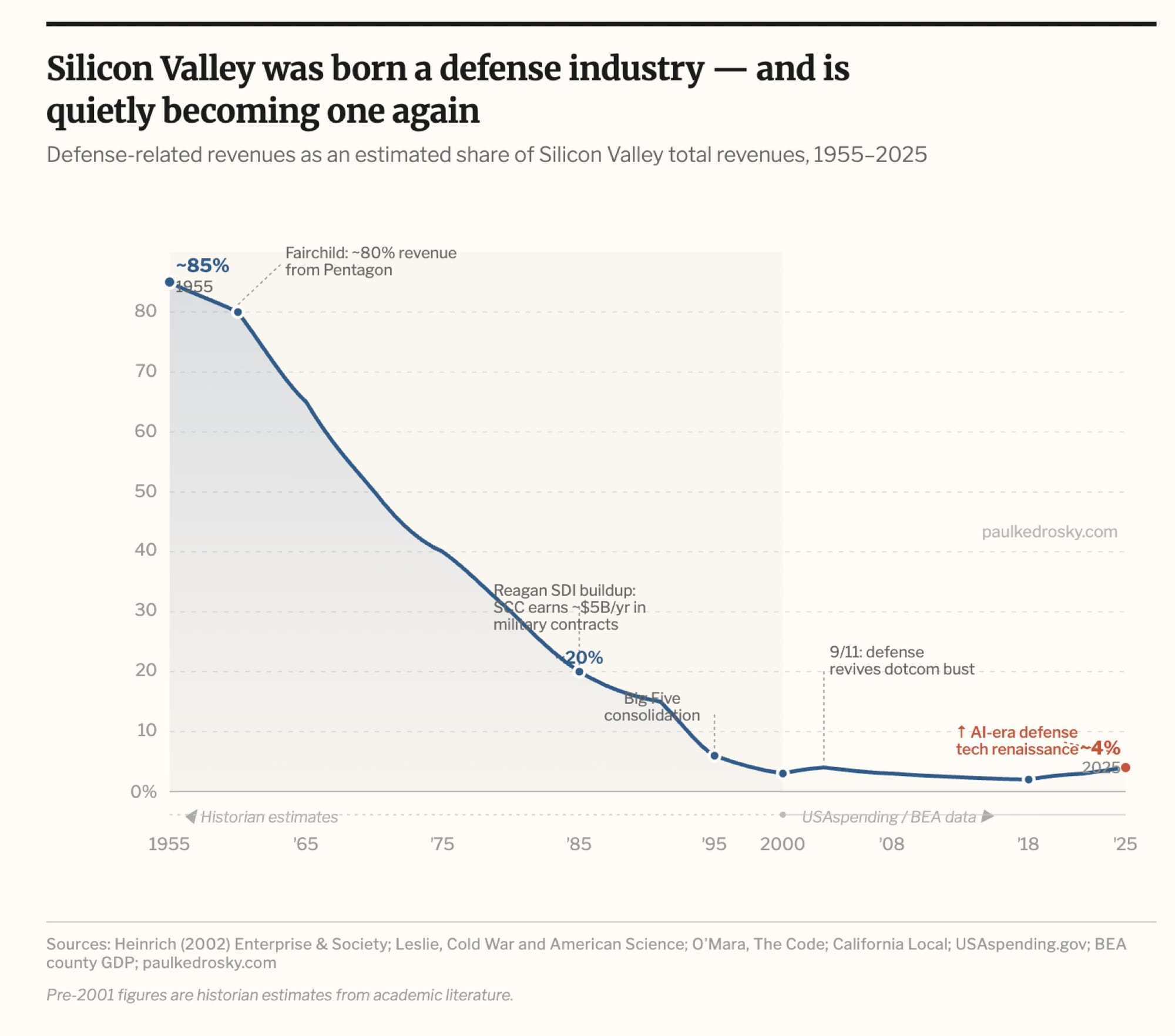
What followed over the next four decades was a long, gradual divorce. Commercial computing, consumer electronics, and the internet created enormous civilian markets. Defense's share of Silicon Valley revenues fell from 85% in 1955 to roughly 6% by the mid-1990s, to under 3% by 2018. The valley became culturally allergic to its own origins: "Don't Be Evil" was partly a repudiation of the industry's founding patron.
The AI era is reversing this, and doing it faster than most observers recognize.
Today defense-related revenues account for an estimated 4% of Silicon Valley's total — very low, but up from its recent trough and rising quickly. The trajectory is what matters, and the nature of the dependency has changed. In the 1950s, defense drove semiconductor fabrication. Today, it drives the frontier of AI development itself.