

Once again, here are recent rough notes from the site:
And now ten of the best ideas of the current century, again from New Scientist this week:
- Electrifying everything
- A computer in every pocket (smartphones)
- Modern AI foundations (deep learning at scale)
- CRISPR and gene editing
- mRNA and preventative therapeutics
- Real-time astronomy and sensing
- Climate attribution science
- Recognition of brain diversity
- Open, networked knowledge hubs
- Dietary evidence convergence
Eclectic and amusing list of the first worst ideas of the last century (from New Scientist):
- Bitcoin / proof-of-work cryptocurrencies
- Profit-driven social media
- Carbon offsets
- Most alternative liquid fuels (biofuels, hydrogen, synthetic fuels)
- Effective altruism (as practised)
Ai has made the global economy more fragile, the IMF argues in an economic outlook update today:
"Risks to the outlook for the global economy remain tilted to the downside. ...
Should expectations about AI-driven productivity gains turn out to be overly optimistic and outcomes disappoint, a sharp drop in real investment in the high-tech sector as well as in spending on AI adoption ... could ensue."
https://www.imf.org/-/media/files/publications/weo/2026/january/english/text.pdf
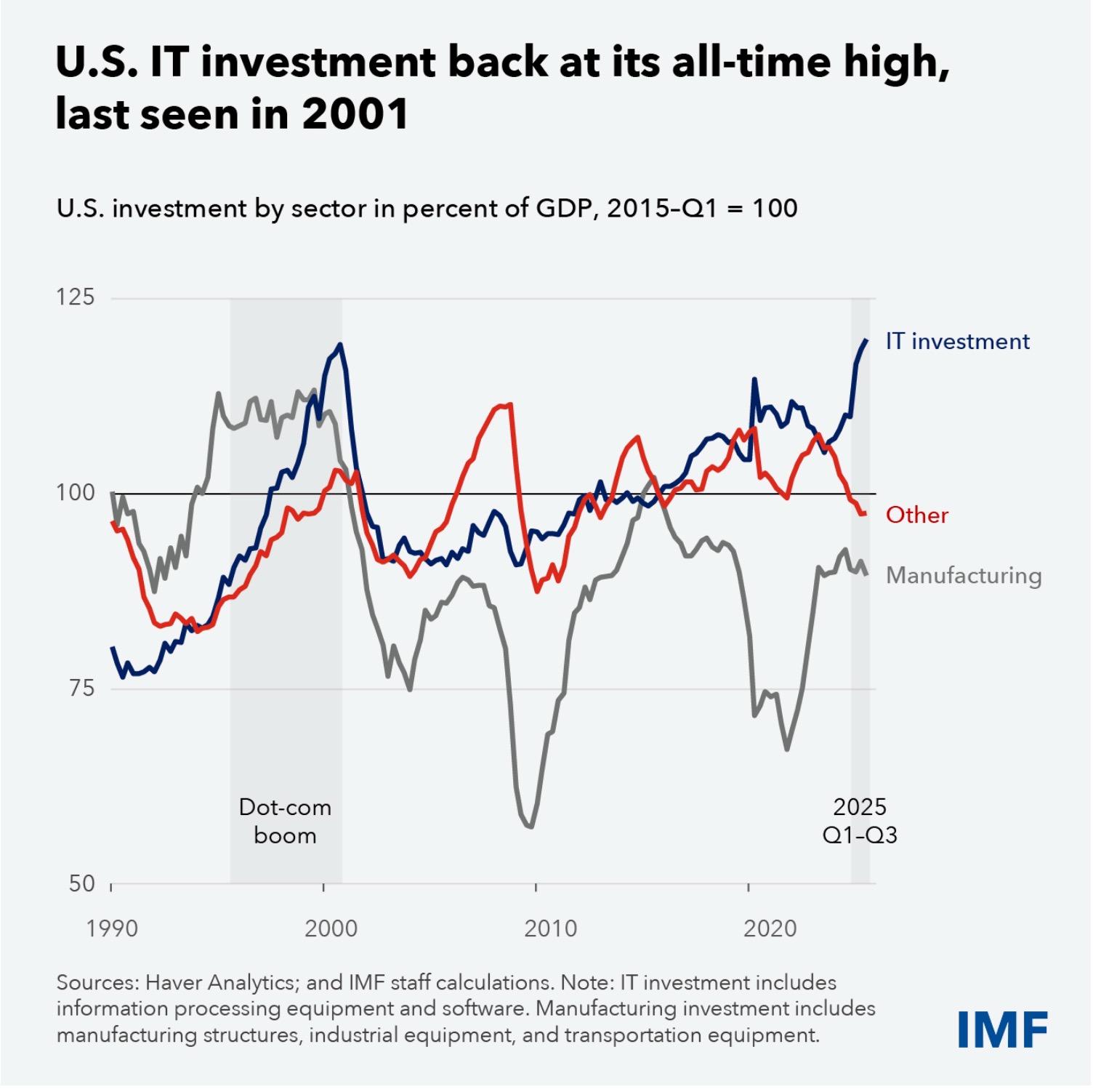
Tech spending, as a percent of GDP, and largely driven by AI, is back to its 2001 all-time high. Remarkable.
Amusing reading from OpenAI CFO bragging that they are successfully selling dollars for $0.70 in huge volume. https://openai.com/index/a-business-that-scales-with-the-value-of-intelligence/
LLMs don’t reason morally; they absorb how humans interact: contracts, hierarchy, coercion, markets, war. Under stress, they reproduce the same strategies. Blackmail, thus, isn’t anomalous. The risk, as a result, isn’t hostile intent but amplification: AI compresses time, removes friction, and forces hidden human contradictions to emerge at scale faster than institutions can adapt.. https://arxiv.org/pdf/2601.08673
New study shows people "punish" others who use LLMs for work: ~36% of earnings from those who relied solely on LLMs, with punishment rising as use increased. And if you claim no use” people don't believe you. https://arxiv.org/abs/2601.09772
Global AI power usage now rivals that of New York state on peak summer days, around 30 GW, and, of course, continues to rise sharply,added sovereign grid-scale capacity every 2-3 years, no longer decades. https://epochai.substack.com/p/global-ai-power-capacity-is-now-comparable?utm_source=post-email-title&publication_id=3755861&post_id=184824056&utm_campaign=email-post-title&isFreemail=true&r=5s9uw0&triedRedirect=true&utm_medium=email

In particular, here are a few things Amazon gets wrong about its own commissioned report, leading my study quibbles:
- The study is partial equilibrium, not full. It doesn't model system changes in supply and demand, thus making it unable to support Amazon's claims.
- Revenue is estimates marginal cost at the time of the subsidy, thus excluding margin tightening, externalities, etc.
- "Surplus revenue" is an accounting term, at best, not ratepayer relevant
Wrt data center propaganda, the Amazon spin of a study it commission—showing no data center effect on rates, it trumpeted—is particular problematic. The study it cites, which it paid for, does not make as heroic of claims as Amazon assigns to it. https://www.ethree.com/wp-content/uploads/2025/12/RatepayerStudy.pdf