

In 1941, Ted Williams hit .406. No professional baseball player in Major League Baseball has hit .400 since. For decades, this disappearance was hypothesized to have something to do with ... something, perhaps modern pitching, night games, or travel. Something was somehow making good players worse.
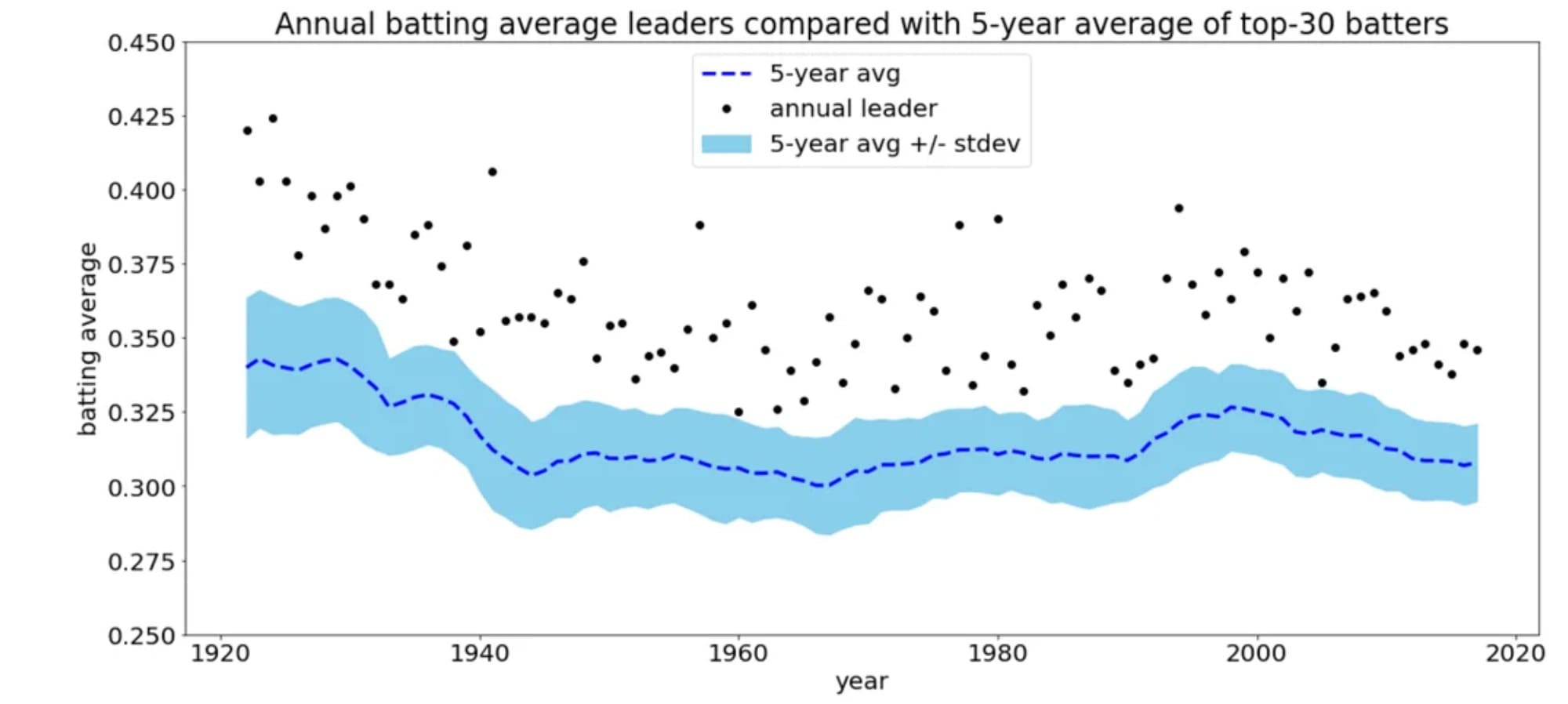
Evoluentary biologist and writer Stephen Jay Gould thought everyone had the story backwards. In his book Full House, he argued that .400 hitters didn't vanish because hitters got worse. They vanished because all players got better. As play improved, player variance collapsed. The mean batting average stayed around .260, but the standard deviation almost halved. In a tighter distribution, a .400 hitter becomes nearly impossible. The gap between average and elite had closed.
The same thing is happening to large language models, and, once again, people are misunderstanding it.
A good place to start is by plotting Epoch's Capabilities Index (a composite of various benchmarks). The trend is linear, not exponential, a steady gain of roughly 16 capability units per period, with an R² of 0.73. The exponential fit is worse than the linear one. Progress that gets told as relentless acceleration is, in the data, a straight line (at best).
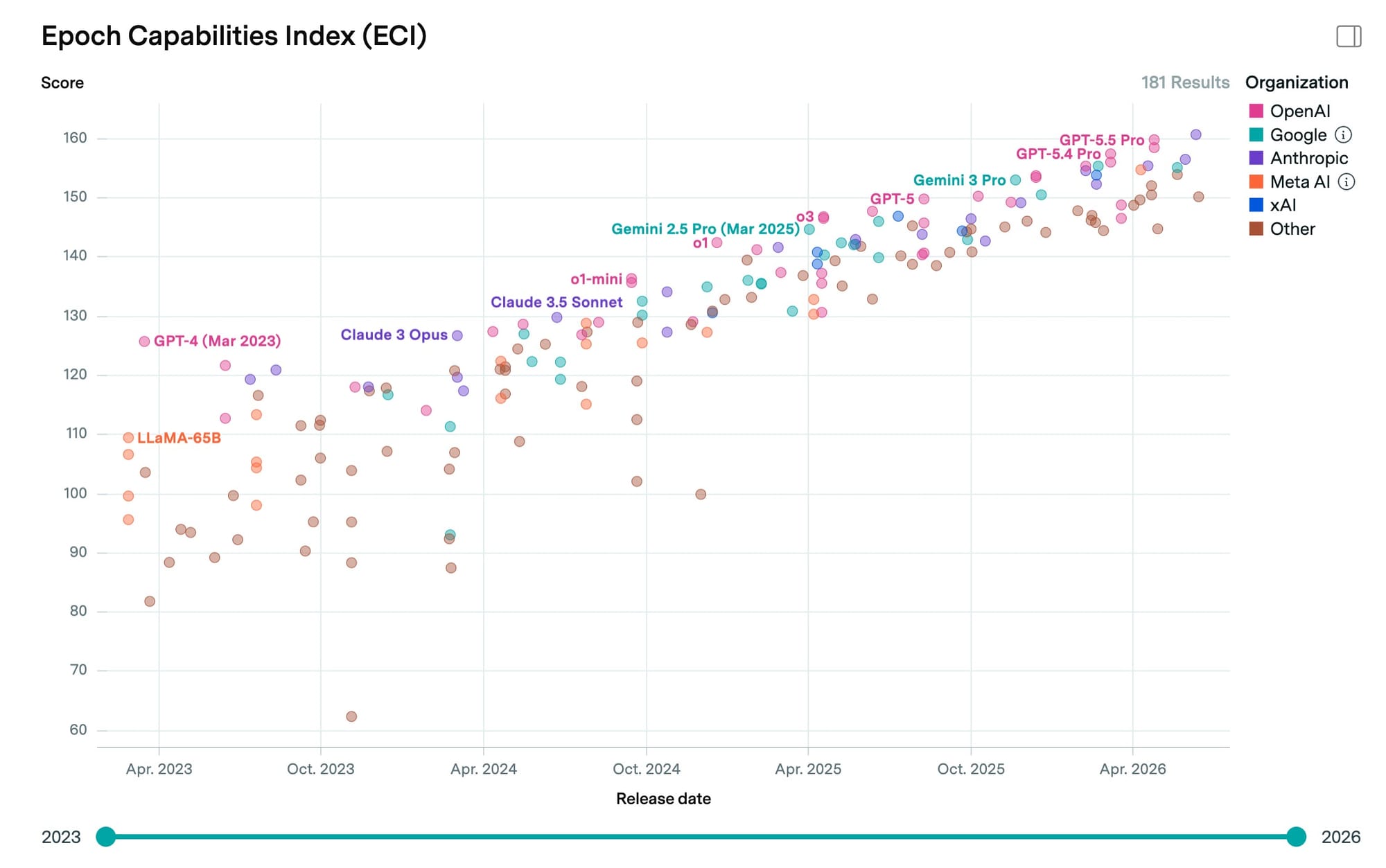
The second thing — perhaps more important — is what happens to the spread of scores over time.