

What Happened
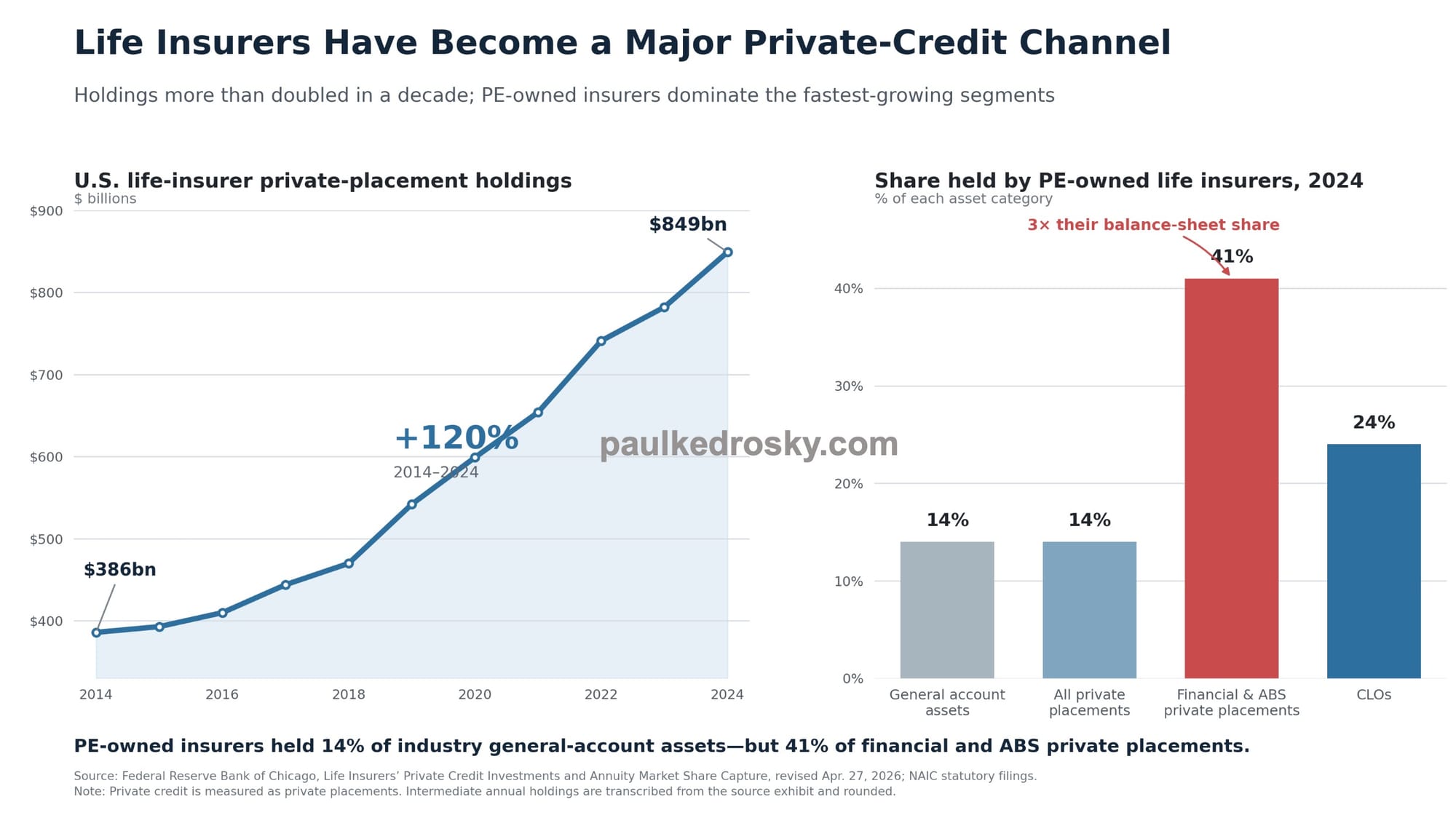
- Private equity has increasingly taken control of life insurers, turning insurance premiums into permanent capital for private credit.
- The asset manager can originate loans, collect fees and direct the insurer it controls to buy the resulting assets.
- PE-controlled insurers now hold a disproportionate share of private placements, structured credit and other illiquid assets.
- Private-credit investments held by US life insurers increased 21 percent in 2025, more than twice the growth of their overall assets. Source
- Federal prosecutors and the SEC are investigating whether Mark Walter’s insurers concealed the extent of this circular financing.
- Delaware Life initially reported about $1.4 billion of affiliated investments.
- After receiving grand-jury subpoenas, it reclassified its holdings and disclosed $17.8 billion of private-credit investments whose returns depended predominantly on affiliated companies.
- Total affiliated investments rose to roughly 40 percent of invested assets.
- Delaware Life now plans to replace as much as $6.5 billion of related-party investments with unaffiliated assets. Source
- This is happening just as AI infrastructure requires an unprecedented amount of private debt.
- Nvidia has announced financing partnerships with Apollo, BlackRock, Blackstone, Brookfield, Goldman Sachs and KKR intended to mobilize more than $500 billion for AI infrastructure.
- Apollo, Brookfield and KKR own major insurance businesses. Blackstone also manages large pools of insurance assets.
- These firms therefore control both the machinery that originates AI-related debt and some of the largest pools capable of buying it. Source
- The SEC has simultaneously made data-center debt easier to manufacture and distribute.
- SEC staff ruled that certain data-center securitizations are not legally asset-backed securities because the issuing vehicle continues to own the facility after the debt is repaid.
- Sponsors can therefore avoid important ABS requirements, including risk retention and much of the associated disclosure regime.
- The structures generally have an anticipated repayment date of about five years, final maturities of 25 to 30 years and little recourse to the sponsor. Source
What It Means
- The AI buildout has found a balance sheet large enough to support it.
- Public bond markets cannot absorb all the required financing.
- Life insurers hold enormous pools of long-duration capital and can buy private assets without daily market pricing.
- They had been an obvious destination for the next wave of data-center debt, but that is now more fraught.
- Syndication may create the appearance of risk distribution without meaningfully distributing the underlying risk.'