

What Happened
- Etched, an AI-chip startup founded by three 24-year-old Harvard dropouts, has begun shipping its first chips.
- The company has more than $1 billion in orders and is raising $700 million at a $21 billion valuation.
- Its first silicon reportedly worked on the first attempt.
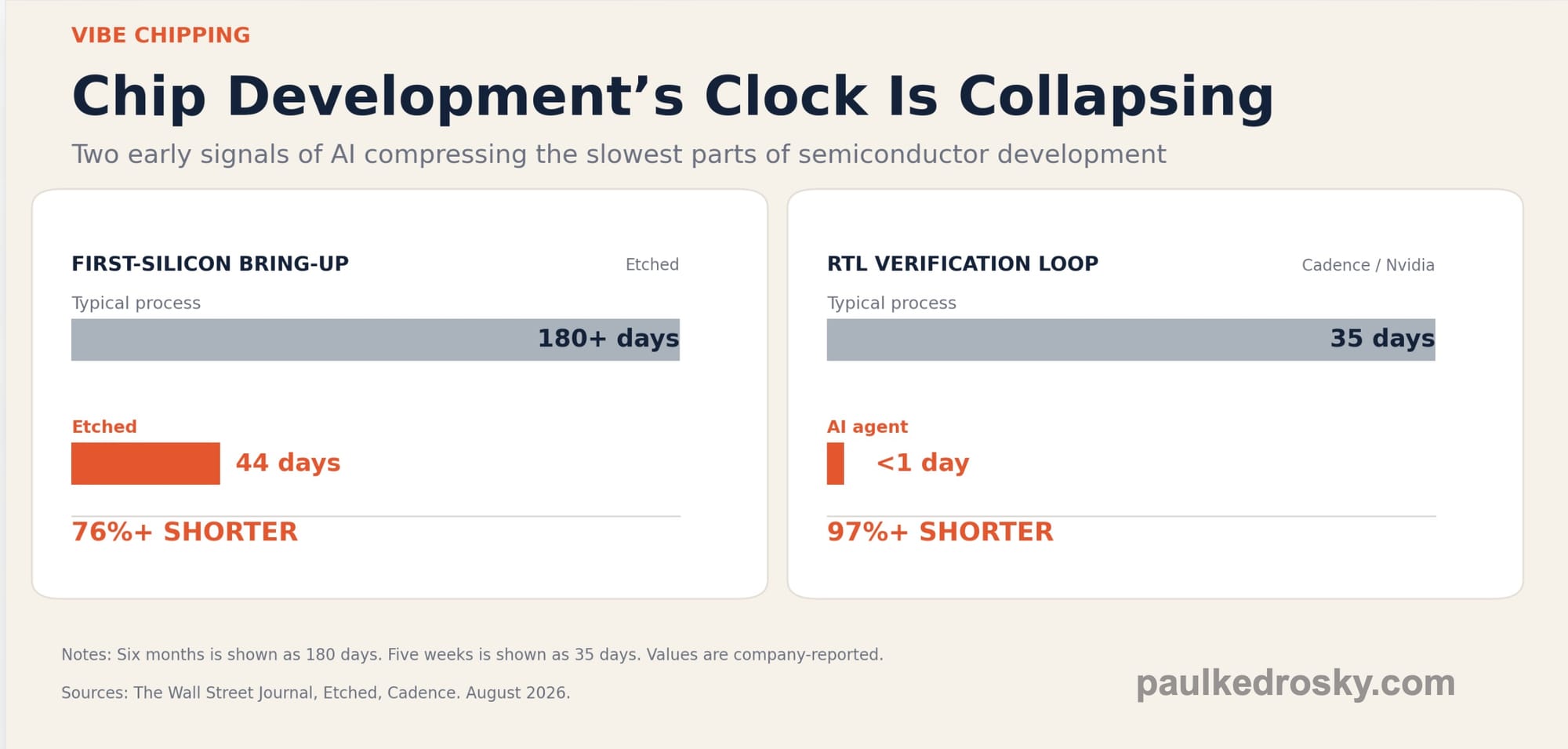
- Etched says it had the chips running inference workloads just 44 days after receiving them from TSMC.
- That process normally takes six months or more.
- The missing detail is how Etched moved so quickly.
- The company is recruiting engineers under the explicit heading: “We are using AI to build AI chips.”
- Its AI agents are being deployed across:
- RTL design
- Verification
- Debugging
- Physical design
- Design-for-test
- Silicon validation
- Its AI agents are being deployed across:
- The company is recruiting engineers under the explicit heading: “We are using AI to build AI chips.”
- This is happening across the semiconductor industry.
- Cadence says its new AI agents can run hundreds of simulations simultaneously.
- This reduces a typical five-week RTL verification cycle to less than a day.
- Synopsys says chip designers using its AI tools are reporting productivity improvements of two to five times.
- Its tools can generate RTL from natural-language specifications, produce verification docs, analyze timing problems and operate conventional design automation tools.
- Cadence says its new AI agents can run hundreds of simulations simultaneously.
Sources: The Wall Street Journal, Etched, Cadence, Synopsys
What It Means
- Vibe chipping has arrived.
- You can describe desired behavior at a higher level, then use agents to write code, operate design tools, generate tests, investigate failures and iterate toward a working design.
- This does not (yet) mean asking Claude to make an accelerator and receiving a finished chip.