


💡
A free edition of the irregular weekend "thinking" pieces that usually only go to premium subscribers.
Three things worth thinking about this weekend:
- Aging populations vs AI
- Tech industry's capex regime change
- The two Michaels—investor Burry and writer Lewis—reminisce
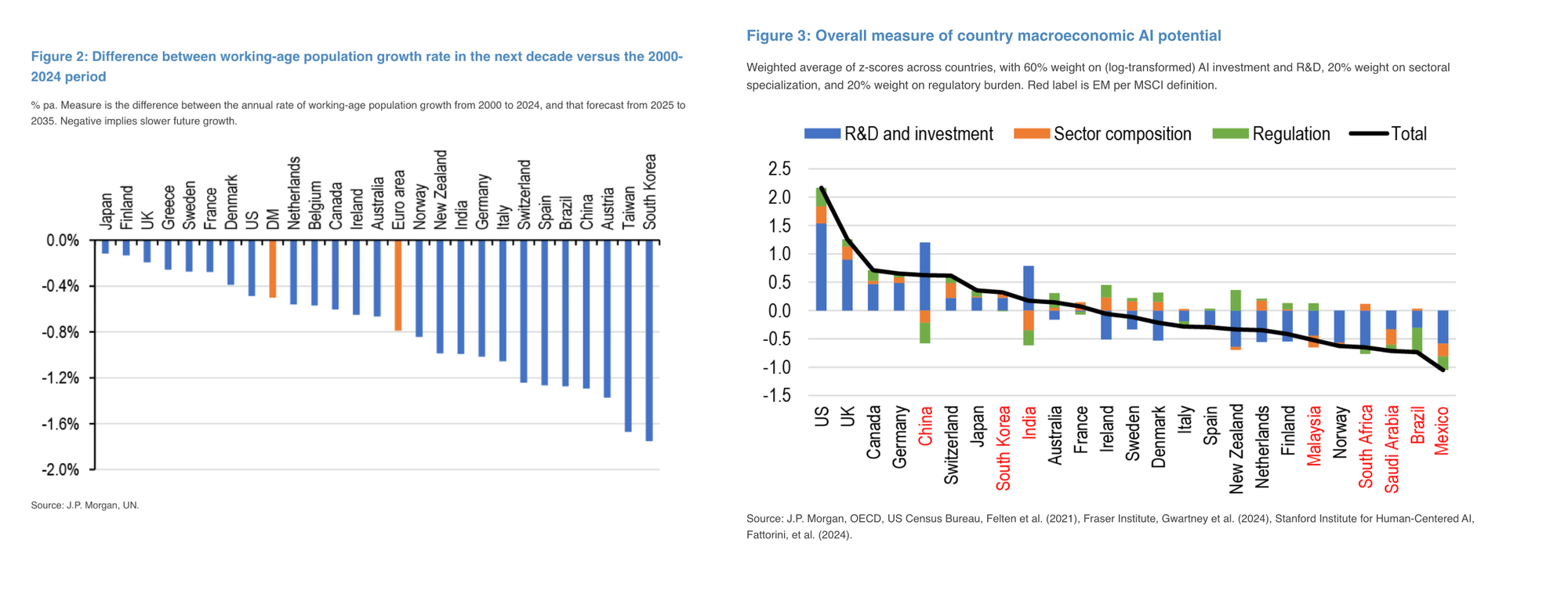
1. On the battle between aging populations and AI-driven productivity gains (JPM)
- Working-age population growth should be reduced by 0.5%-points pa in the US, 0.8%-points pa in the Euro Area, 0.1%-points pa in Japan, 0.2%-points in the UK, 1.3%-points in China, and 1.8%-points in South Korea.
- The median assumption from studies is that Al will raise labor productivity growth by 0.5-1.0%-points pa in the coming decade, depending on the exposure of a country to Al.
- On average, the effects of Al on labor productivity look to be similar in size to the growth effects of slower working-age population growth vs. 2000-2024.
- This will make AI effects on growth a wash, at best.
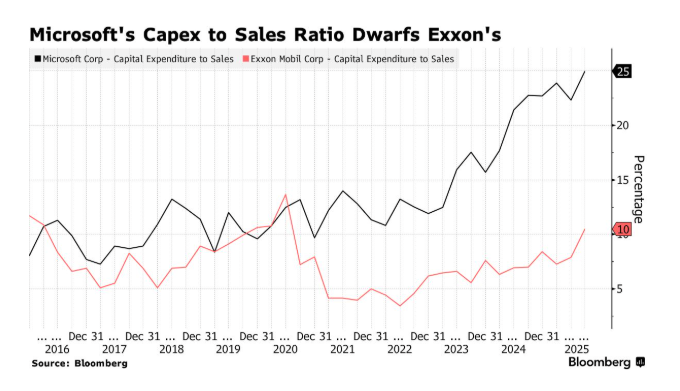
2 Tech's industry capital expenditure regime change over the last decade (Bloomberg)
- Tech used to be a low capital expenditure business with cheap scaling, but that began changing five years ago.
- Its capex spending has intensified in recent years, with it, for example, now 25% of Microsoft's revenue, a tripling from 10 years ago.
- Microsoft's capex to sales ratio now dwarfs Exxon's.
- Despite the regime change, funded in part by debt, tech companies are pricier than ever: Microsoft shares trade at more than 28 times projected forward earnings, higher than its 10-year average.
- Because of the spending, Meta and Microsoft are expected to have negative free cash flow after accounting for shareholder returns next year.
- A more capital-intensive tech industry will likely drive a more boom-bust cycle.
3. The Two Michaels Talk AI and the Big Short (Apple Podcasts)
- Writer Michael Lewis and investor Michael Burry talk for the first time in more than a decade, after The Big Short movie and book
- The latter was forced to be more public, he says, after a "small" put position against Palantir and Nvidia leaked.
- His thesis is/was:
- Palantir is a consulting-heavy government contractor that slapped an “AI” label on old software.
- Nvidia is a graphics-chip company that lucked into two consecutive manias (crypto, AI).
- Palantir has a “billionaire-to-revenue ratios > 1,” a red flag Burry has never seen before.
- AI capex is like the 2000 fiber build-out, and market peaked when spending was only half-done, so bought 2-year options.
- 50 % of U.S. equity money is now passive, so there are no neglected stocks: everything moves together.
- Not one investor ever apologized for threatening to sue him during the "big short" trade.
- He has never re-watched the Big Short movie or re-read Lewis's book.
Have a good weekend.