


Four notes on how stress is finally showing up in the data center credit complex:
- The OpenAI Debt Backstop
- The Oregon PUC Power Debacle
- CoreWeave CDS Blowout
- What is the TAM on Replacing Humanity
Let's do this:
- The OpenAI Debt Backstop
The recent flare-up around OpenAI’s semi- proposed debt backstop reveals the structural tension between venture-style growth and infrastructure-scale spending, especially when the two become wrapped in the flag. The company's CFO’s comments floated the idea of a government guarantee for data-center financing — a remarkable signal that AI build-out costs have reached utility proportions. Sam Altman’s follow-up disavowed any such plan, saying OpenAI should “fail if we get it wrong,” but the damage was done. Investors now see an enterprise straddling the line between startup and state-sponsored critical infrastructure, with an overlay of an implied "Greenspan put"—that AI is so important it can't be allowed to fail.
The optics matter: lenders must begin to price OpenAI more like a sovereign-backed utility than a growth company. The episode marks the point where AI financing entered the quasi-public domain. Even if the “backstop” was rhetorical, it exposed how fragile the capital structure behind this compute-intensive ecosystem has become.
It has also led to umpteen thousand memes, and, amusingly, a Polymarket betting line on when Sam Altman finds himself a new house.
- The Oregon PUC Power Debacle
Connecting data centers to the grid has now turned into open warfare between tech firms and utilities. Amazon’s complaint against PacifiCorp — filed with the Oregon Public Utility Commission — accuses the Berkshire Hathaway-owned utility of failing to deliver sufficient power to four new data-center campuses. The filing alleges that PacifiCorp provided only partial power to one site, none to a second, and has “refused to even complete its own contracting process” for two more.
Some more tidbits:
- Extraordinary remedy sought — revocation of PacifiCorp’s exclusive service territory
Amazon explicitly asks the Oregon PUC to remove its facilities from PacifiCorp’s monopoly territory and reassign them to a utility “ready, willing, and able” to serve. That’s a rare and extreme regulatory demand; territory reallocation is almost never sought, let alone by a Fortune 500 customer. - Alleged unilateral “32.6% tax gross-up” demand
PacifiCorp is accused of imposing a post-contract policy change adding a 32.6% surcharge on all capital contributions—retroactively—without regulatory or contractual basis. ADS contends PacifiCorp invented this internal rule years after contract execution.
It is, as they say, bananas.
PacifiCorp’s response, that it must avoid “direct and indirect harms between customers,” highlights the underlying conflict. The utility claims it cannot endanger ratepayer affordability by over-committing generation to hyperscalers. Amazon, meanwhile, argues that PacifiCorp breached 2021 obligations and is stalling projects worth billions.Some
The episode exposes the structural tension at the core of grid policy — decarbonisation mandates and utility over-eagerness for new annuity-paying loads, plus political pressure, without corresponding capacity investment. Oregon’s utilities, still operating on legacy load models, cannot finance or permit new infrastructure fast enough. In all likelihood, no-one can. The result: rationed power, legal confrontation, and an augury.
- CoreWeave CDS Blows Out
I have written about CoreWeave a few times here, pointing out that it is among the more speculative data center sponsors. That is increasingly coming home now, as the company's credit default swaps show.
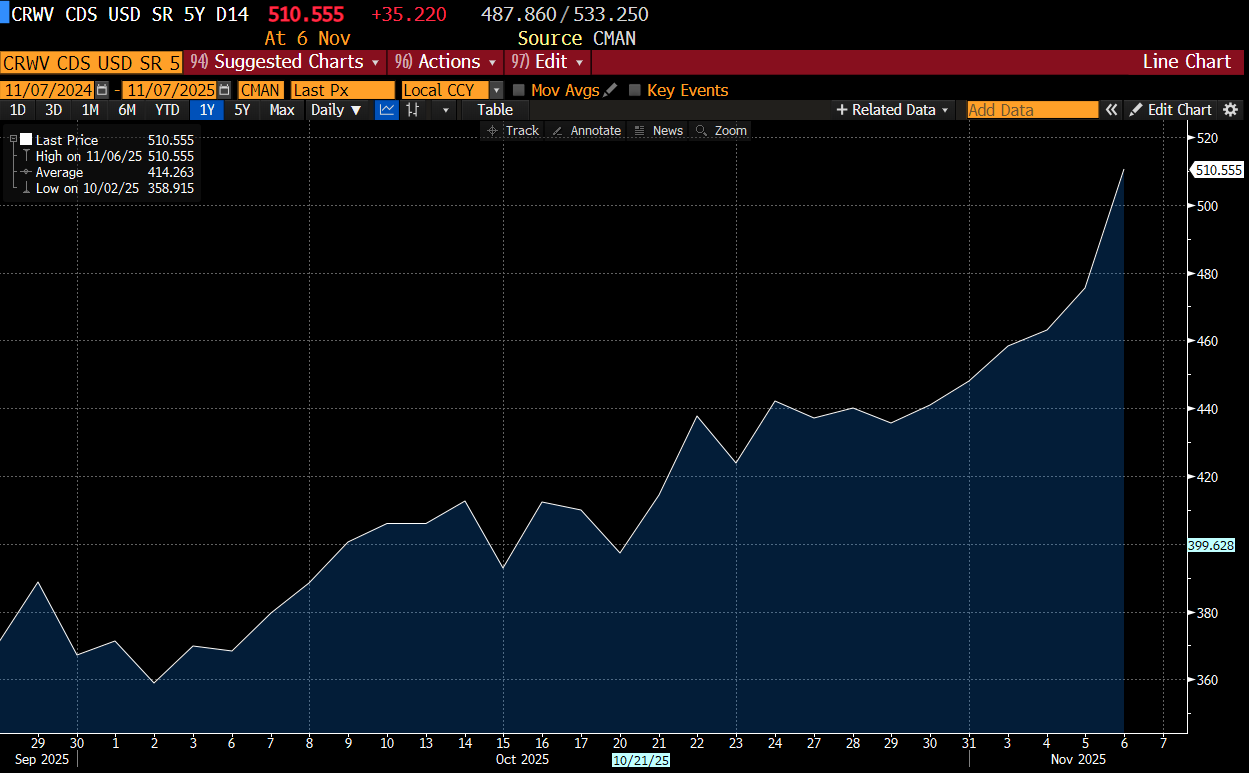
That chart shows CoreWeave’s 5-year USD senior CDS (credit-default swap) spread going out sharply — now at ≈510 bps, up from ~360 bps in early October 2025.
Keys:
- Credit risk repricing: A 510 bps spread implies markets now demand > 5 % annual protection cost against CoreWeave default, roughly double early-fall levels. That’s a major deterioration in perceived credit quality.
- Steep late-October acceleration: The curve steepened into November.
- Macro backdrop: Wider moves echo stress across the AI-infrastructure credit complex—other GPU-linked names (e.g., hyperscale lessees, power-infrastructure ABS) are also widening, reflecting skepticism on 2026–27 cash-flow realization and project-finance rollovers, crossed with, you know, other issues in the more speculative debt market.
- Prior levels were artificially tight. The early-2025 spread (~250–300 bps) priced CoreWeave almost like an investment-grade-adjacent credit, which, as I've previously argued, made little sense given its leverage, tenant concentration, and project-finance structure.