


People are newly excited again at AI progress. After a period where it felt like AI models weren't changing as much, that they had turned into mobile phones, with minimal progress, something has changed.
But people are confused, as I will show. To understand why, first understand that the headlines and hyperbole are mostly not about models. They are about new tools, like Claude Code and Codex, from Anthropic and OpenAI, respectively. Interest surged in the past year.
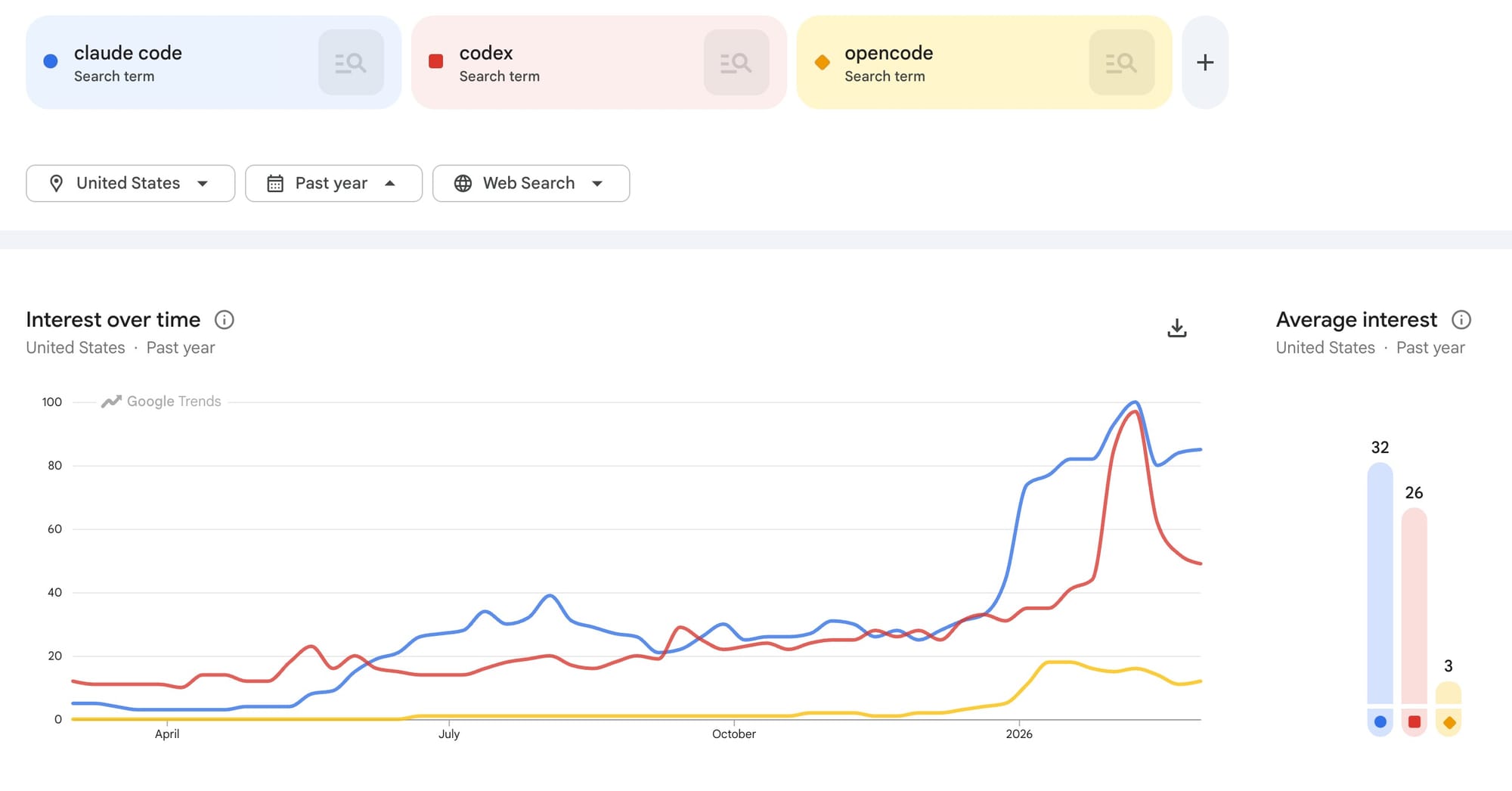
Such tools are important, but they mask at least two things.
1. Models have not re-accelerated with respect to capability. If anything, model progress has slowed even further, as I will show below.
- A new layer has emerged that has changed AI dynamics for good, putting much of current AI training spending at risk.
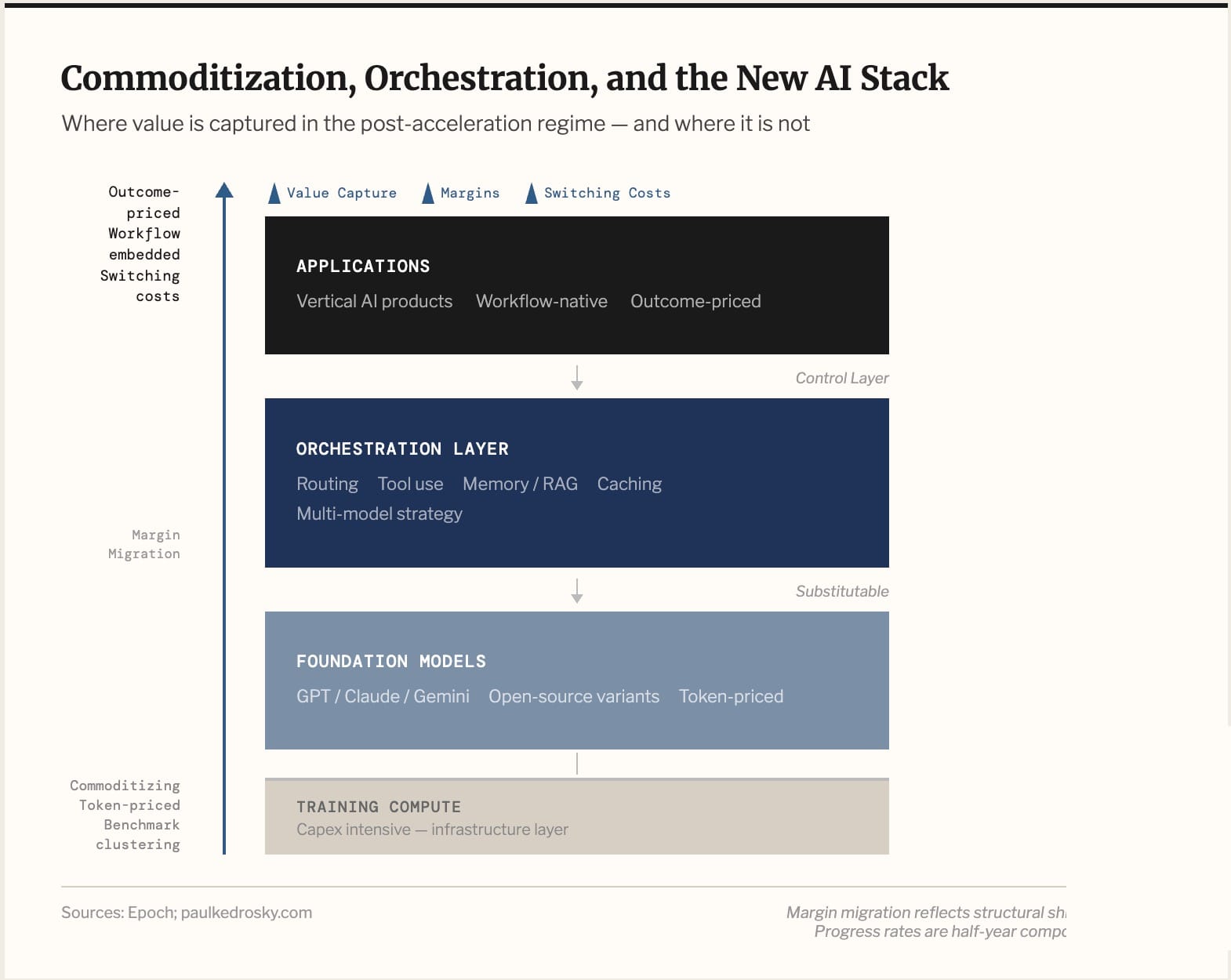
The takeaway is this: Large language models are the new silicon. Orchestration layers, like Claude Code and Codex, are the new operating systems. Applications are the new productivity suite. As raw model improvement slows, value migrates up the stack. This will have huge implications, from model commoditization, to inference traffic, to stranded training spending.
Here is how to think about the new layers, where value is going, and what is being commoditized:
Now let me explain why this is happening.
LARGE MODELS AND ORCHESTRATION LAYERS
First, however, two quick definitions:
Neural networks trained on vast text corpora to predict and generate language, forming the foundational reasoning and pattern-recognition layer of modern AI systems.
Orchestration Layers (e.g., Claude Code, OpenCode, Codex):
Software frameworks that coordinate models, tools, memory, and execution environments—turning raw LLM capabilities into structured, task-oriented workflows and usable applications.
The key to understand what is going on is to understand that orchestration layers now dominate models. While models are not irrelevant, they are far less important than they were even a year ago. Slowing model progress—the next section—is masked and made less relevant by improved model coordination, which has immense capex implications.