

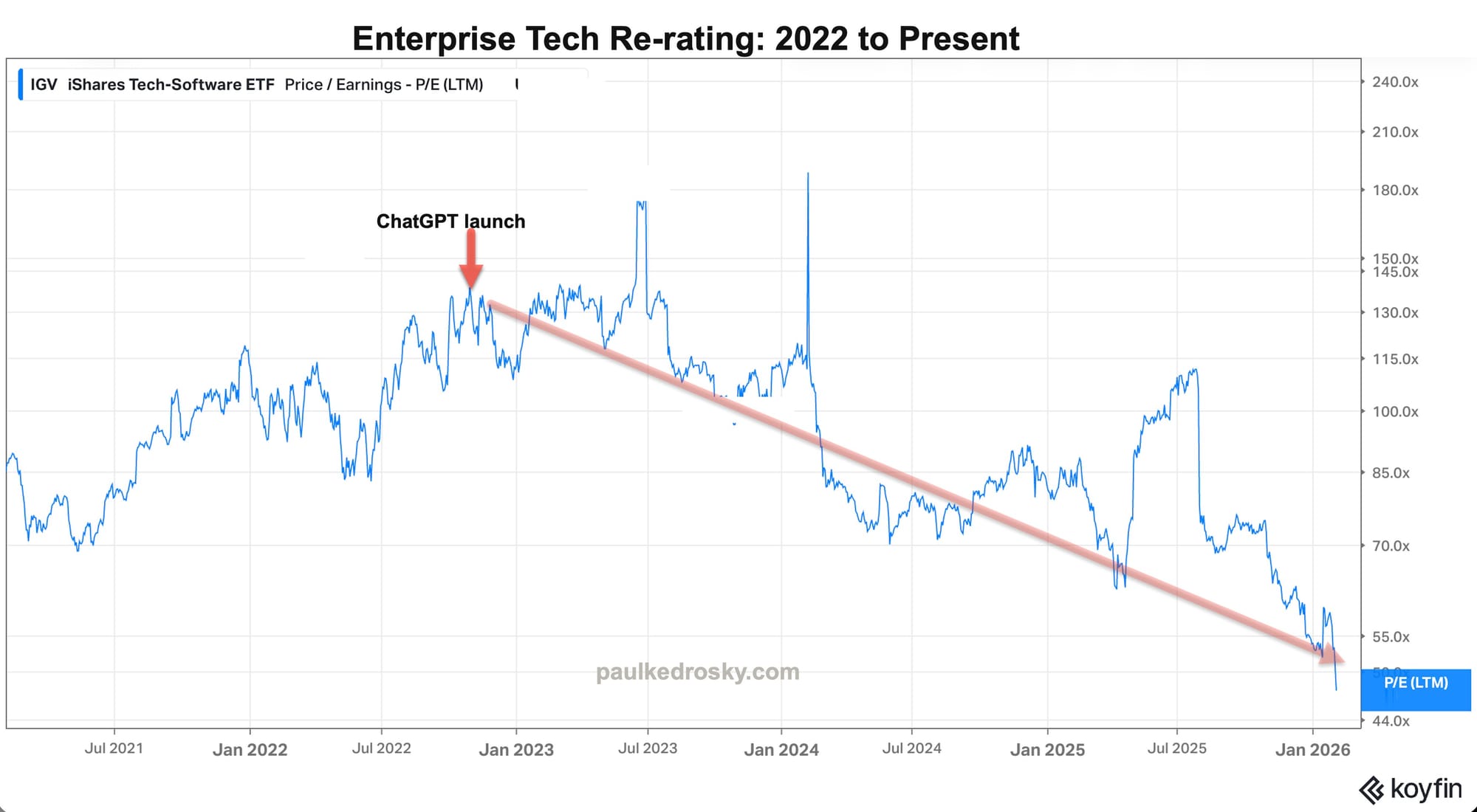
There are endless headlines about the ongoing SaaSpocalypse, the re-rating of tech companies, especially in enterprise software, as AI is thought to be eating ... software itself. But as the following chart shows, it arguably began years ago, closer to the launch of ChatGPT in late 2022, even if it has recently accelerated.
The following chart shows the re-rating of the enterprise tech sector: the declining price investors are willing to pay for software earnings. Granted, the P/E multiple is still hefty, in part because of the mix of holdings in the enterprise tech IGV ETF, but that shouldn't distract from a fundamental revaluation that's been going on for some time, despite an advancing equity market.
This has had myriad and growing implications, from trouble in private credit and leveraged loans to, well, declining net worth. Bloomberg newly has out a helpful sample of enterprise software CEOs (and one enterprise software investor) and their wealth losses, now more than $60b in total. The individual numbers are large:
- Adam Foroughi, AppLovin, –$7.8B, –30%
- Dave Duffield, Workday, –$2.7B, –19%
- Larry Ellison, Oracle, –$40B, –16%
- Brian Armstrong, Coinbase, -$5b, –18% YTD (–44% since Oct)
- Orlando Bravo, Thoma Bravo, ~$1.8B, –12%
- Scott Cook, Intuit, –$2.0B, –17%
Is the market correct with its savage AI-aided enterprise software re-rating? I have two views on this:
- The tech industry itself has always been the primary productivity beneficiary of tech, as a recent Chicago Fed study showed. And so a technology—AI—that reduces the marginal value of software to zero¹ is a ticking margin bomb for the industry.
- The notion, however, that companies will began to self-satisfy by producing their own software, using AI, seems naive. A fundamental tenet of capitalism is that companies specialize in areas where they get the most leverage, and while they might cut enterprise software costs, it is unimaginable they will go full roll-your-own provider to themsleves². More like the software industry devolves into something more like Haliburton and similar services providers, consolidating and providing services around what is essentially a commodity.
¹ It doesn't really do this, so hold off on the cards and letters. Directionally, however, that is where we are headed, with a profusion of software—just try to find someone you know who hasn't newly "created" an app, I defy you—often produced at low cost and on a whim.
² And we have tried this in the past, in the early days of software, and it turned out badly, leading in part to the Y2K mess, as non-tech companies YOLO-ed their way along with home-grown and unmaintained COBOL code that turned out to run pretty much everything.