


What executivestypes worry about is often like the old joke about management consultants: They borrow your watch to tell you what time it is, or maybe what time it was. It can be a lagging indicator. But tracking how perceived risks change over time is a useful risk barometer.
Oxford Economics and RepRisk surveyed 513 financial-sector C-suite executives in January 2026, and the shift in "perceived conduct risk" is sharp: three years ago, executives were most focused on classic financial misconduct like corruption and bribery, with AI at the bottom. Looking ahead three years, however, they now rank AI-related conduct as the top risk.
Check the following figure to see the flip-flop.
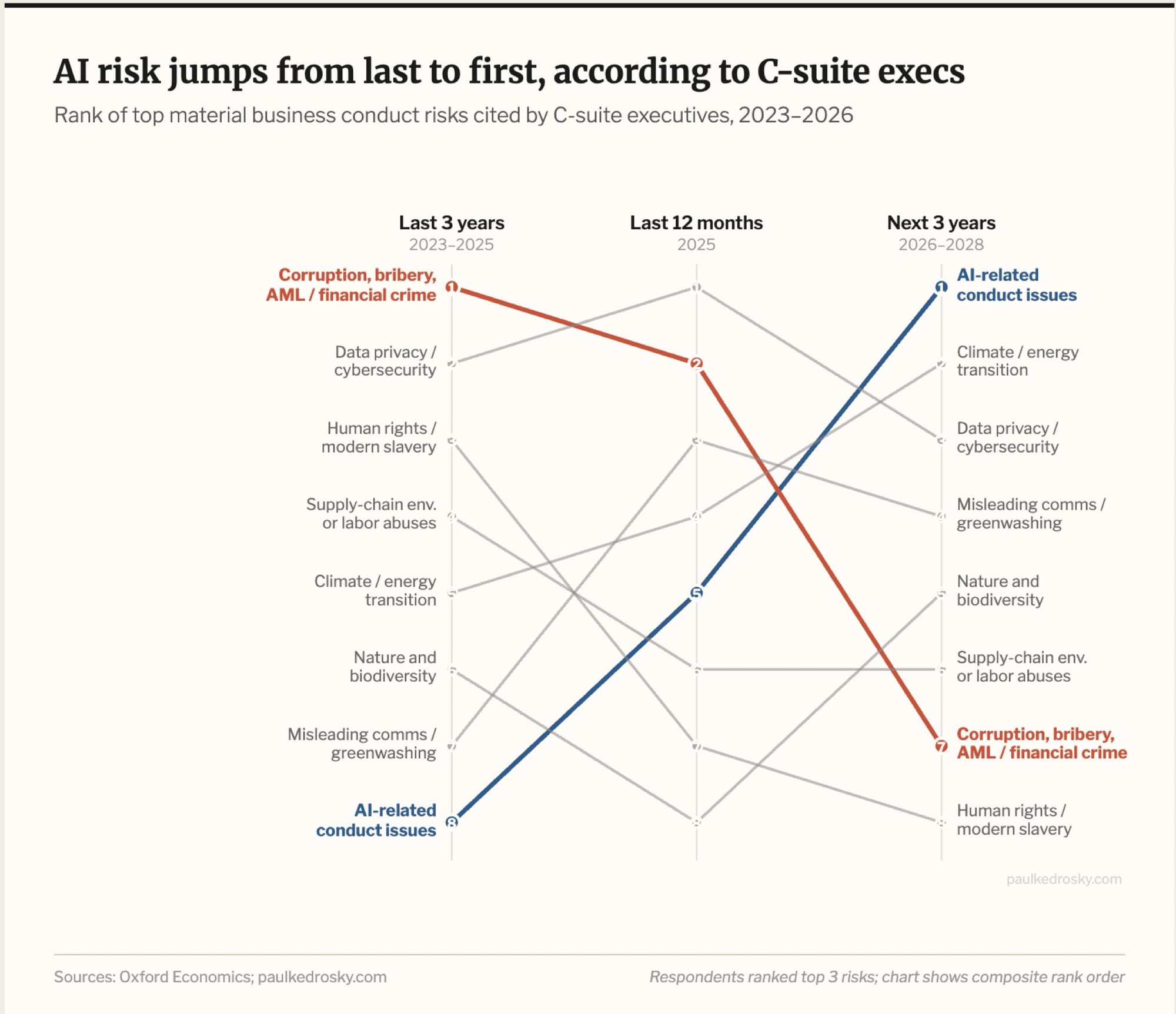
This is among the sharpest changes in any corporate risk factor in recent years. Executives know that AI has, according to survey data, penetrated their organizations at every level, creating endless opportunities for trouble, and they are appropriate unnerved. It will inevitably become financially material.
The increased risk will play out in many ways, in particular via insurance. The view of reinsurance executives is that AI risk, by being embedded in current policies, is seriously mispriced. It will eventually, likely after a few major incidents, be carved out and priced separately, perhaps becoming a new rider.
In current insurance AI risk is largely absorbed into existing lines (cyber, E&O, D&O, professional liability). The pricing, as a result, reflects legacy loss models, not AI-specific failures which are ... legion, correlated, and large.
Mispricing is, therefore, almost certain, given all the ways things can AI-break:
- Correlation risk: same model/vendor → simultaneous failures across many insureds.
- Attribution ambiguity: hard to separate human vs model error → coverage disputes.
- Scale/velocity: bad outputs propagate instantly (customer comms, trading, advice).
- Data leakage/IP issues: exposures are not cleanly mapped to existing policy exclusions.
Failures are over-determined and mispriced, a bad combination.