


A curious possibility sits at the center of the current AI boom: the economy can appear to grow while the demand that normally sustains that growth quietly weakens.
Call it a ghost economy. As I have repeatedly written, GDP can rise with investment ("I" in GDP terms), despite everything else in GDP being weak, or even falling. It is just math.
A recent macro-financial stress-test paper argues that, alongside rapid AI adoption, this is economic "ghosting" is a plausible future, given a growing mismatch between output and income.
The core idea is simple: AI raises production while simultaneously weakening labor income. That mismatch produces what the author calls Ghost GDP: output continues to rise even as the income that supports consumption falls.
But it is even more insidious. Most economic institutions are tied to an assumption: human cognitive labor is scarce and predictably compensated. AI, however, undoes this scarcity, and does so at speed. These institutional anchors—assumeptions about scarce cognition—newly become sources of fragility.
The displacement spiral
This results in a feedback loop that begins at the firm level.
Each company has an incentive to substitute AI for labor. But when many firms do this simultaneously, a macro problem emerges.
- Firms automate tasks.
- Labor income declines.
- Consumption falls.
- Demand weakens.
- Firms respond to this margin pressure by automating even more.
This is the displacement spiral. It can, of course, stabilize if new jobs emerge quickly enough—what economists call task reinstatement. But if automation spreads faster than new tasks appear, the labor share of income declines and keeps on going down. That is already happening, of course, and has been for some time.
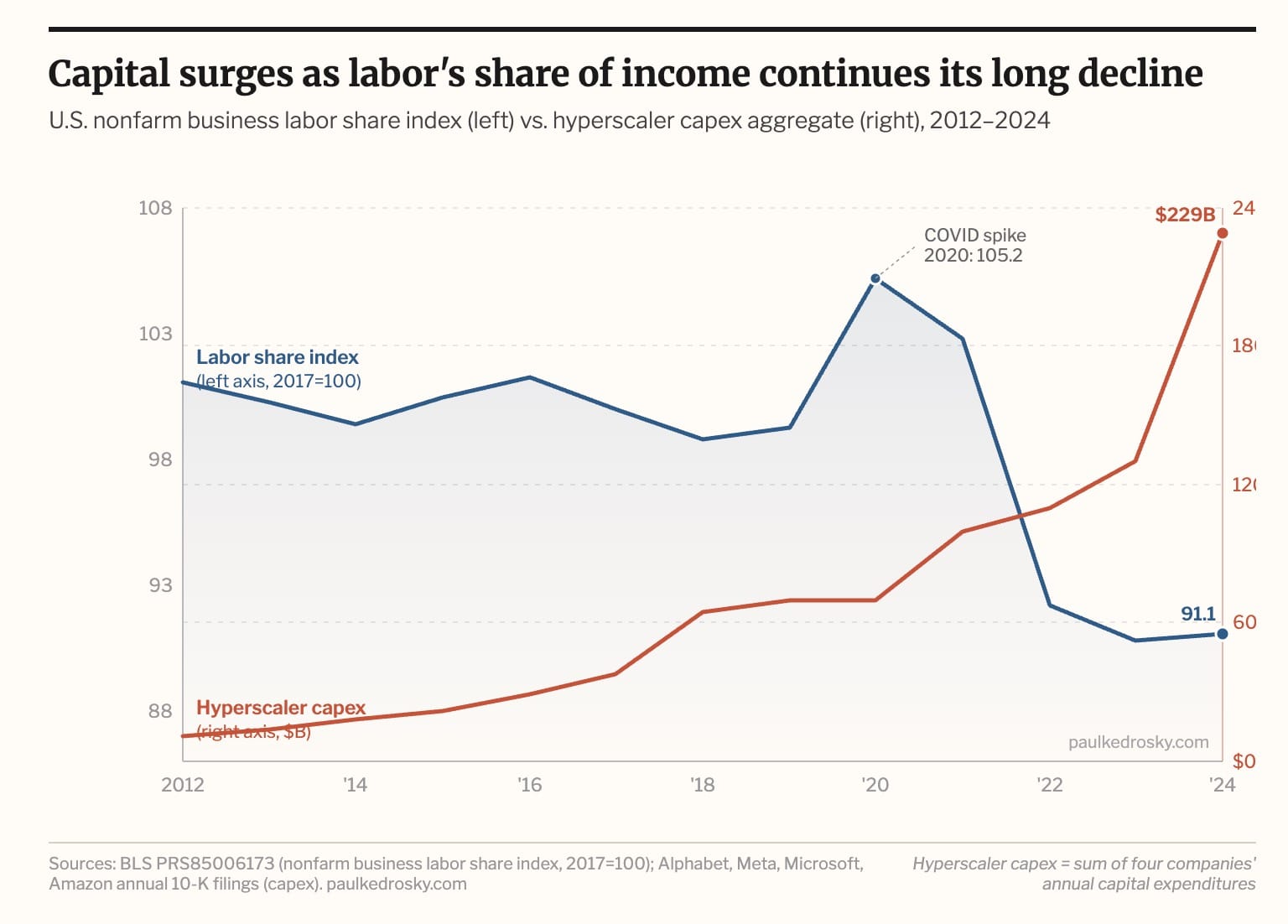
Historically that reinstatement channel has saved the economy. "Technology always creates more jobs than it destroys", as the faith-based line goes. But AI is attacking the exact sector — cognitive work — where new tasks (not merely jobs) have historically formed after prior automation episodes.
The capex illusion
This is where the current AI boom gets interesting.