

“They're trying to kill me," Yossarian told him calmly.
"No one's trying to kill you," Clevinger cried.
"Then why are they shooting at me?" Yossarian asked.
"They're shooting at everyone," Clevinger answered. "They're trying to kill everyone."
"And what difference does that make?”
― Joseph Heller, Catch-22
A broader complexity point on the Situational Awareness blowup, because the event already risks being misunderstood.
Summary:
- It wasn't about AI.
- Aschenbrenner wasn't targeted for destruction by short-sellers.
- There are immense implications for IPOs later this year.
The Situational Awareness blowup was not simply a bad bet on AI, or a violent short-seller attack on Aschenbrenner’s portfolio, as he has claimed. The mechanism was both simpler and more complex. SA owned a concentrated set of highly correlated assets, financed with 3-4x leverage, enough that a large move in one part of the system forced selling everywhere else.
SpaceX provided the initial disturbance in this complex and tightly-coupled system. Its enormous valuation, combined with a relatively small public float, created a rebalancing problem. Funds do not keep idle piles of cash waiting for a major new listing. They sell what they already own to buy what they want to or must own, and they sell the most liquid names (because it's easy), and usually the winners (to lock in gains).
That meant selling semiconductors and other AI winners to fund SpaceX purchases, as I have cautioned previously was coming. Its subsequent addition to the Nasdaq-100 index triggered another round of forced reallocation, made more violent and systemic by all the ETF-abetted leverage in the system, like SOXL, but especially single-name ETFs. When SpaceX itself began falling, the pressure evolved, but the damage had been done.
Check the following graph to see a temporal connection between SpaceX IPO and the unwinding of the semiconductor leverage complex.
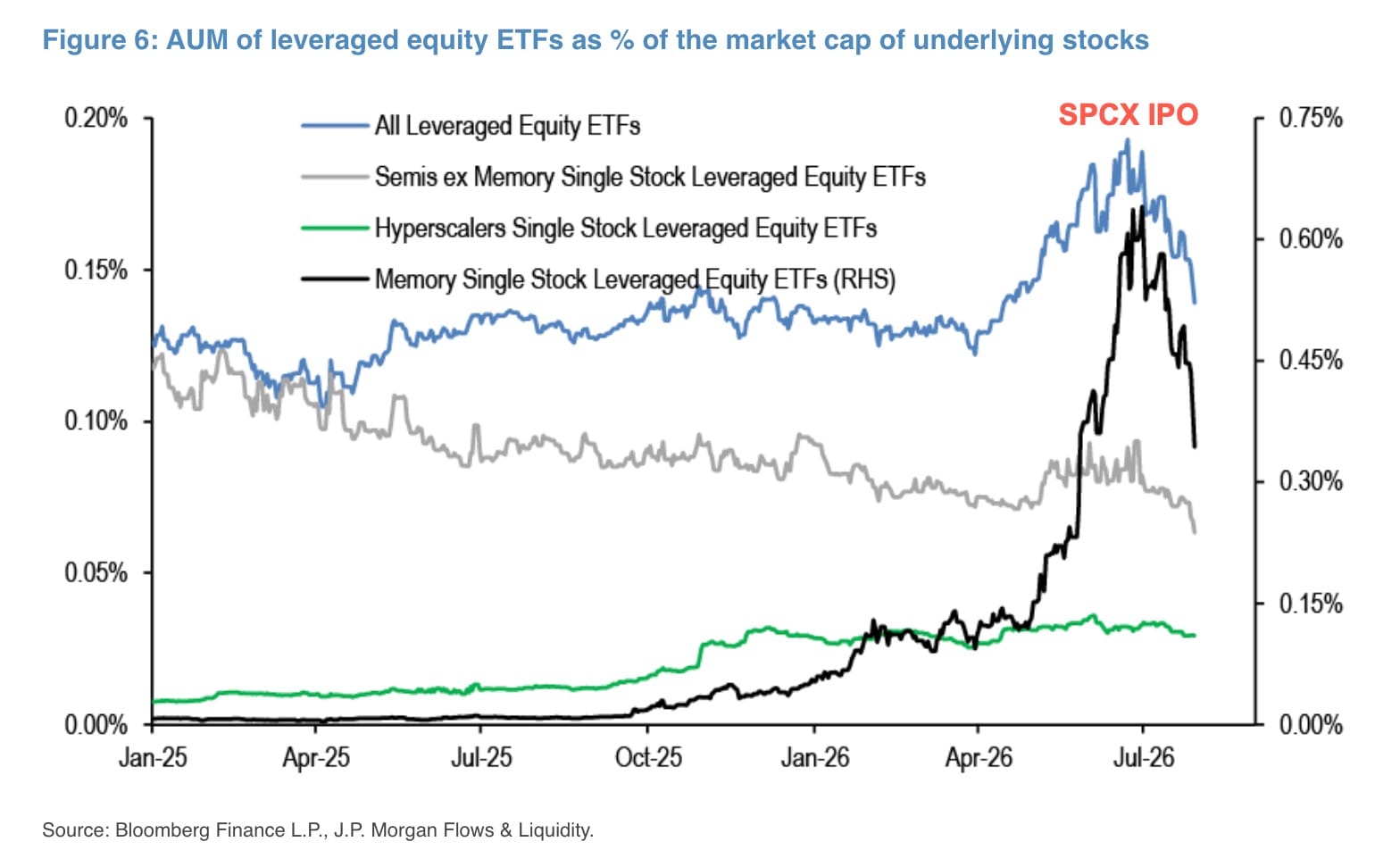
SA was caught inside all three waves.