

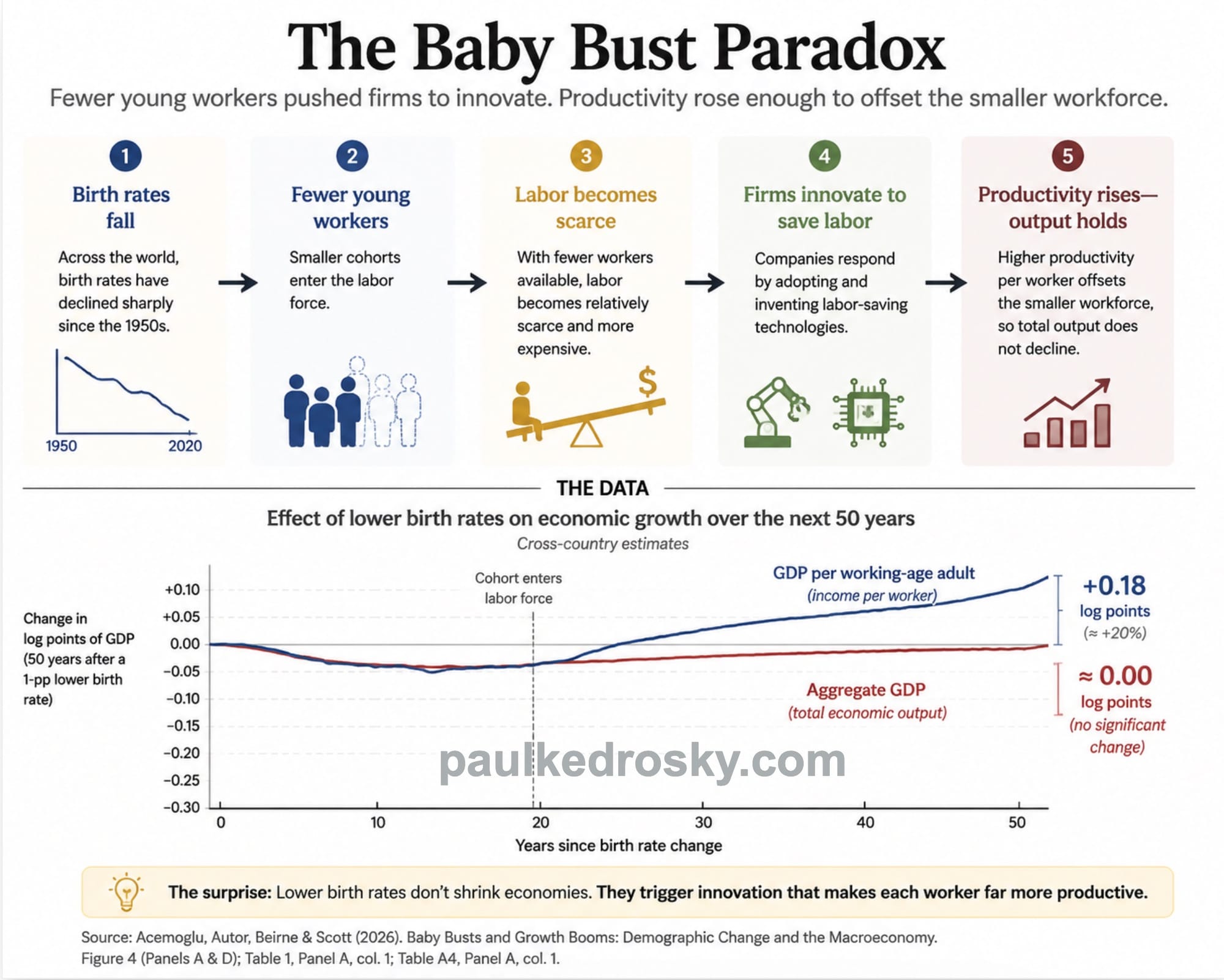
Falling birth rates shrink the workforce and slow economic growth. This has been economic orthodoxy since Adam Smith. New research finds the (almost) opposite, however.
Countries with larger baby busts eventually had faster output per worker growth, while total economic output remained broadly unchanged. The reason is adaptation: fewer younger workers encouraged firms to automate, invest in labor-saving technologies, and reorganize production. Rather than simply producing less with fewer people, economies changed how they produced, which increased productivity enough to offset a smaller workforce.
Call it the Baby Bust Paradox, and here is what it looks like:
Some implications:
- AI adoption will be driven by demographic change.
- Aging societies create structural incentives to automate.
- AI adoption may be driven as much by labor scarcity as by breakthroughs in machine learning.
- Demographics could become one of the strongest long-run drivers of AI deployment.
- The economic winners of aging will be technology-producing economies.
- Countries that develop automation, robotics, and AI may benefit twice
- First, by offsetting their own labor shortages
- Second, by exporting those technologies to every other aging society.
- Demographics could reinforce, rather than weaken, technological concentration.
- Countries that develop automation, robotics, and AI may benefit twice