

Here are some things I'm thinking about in a week of travel (me) and largely demented developments (the world).
Things
- Nvidia's puts its balance sheet at risk to create a GPU asset class
- Hyperscalers are using exotic contracts to avoid adding debt
- Growing numbers of workers training robotics to replace them
- The data-center boom is creating jobs, briefly and unevenly
- The AI boom is entering its financial phase
- The jobless boom is mostly about demographics, not AI
- LLM Judges Change Their Verdicts When Pressed
- Data center outage nearly took out a large chunk of US power grid
- Models are less likely to suggest nuclear attack if you prompt in Japanese
1. Nvidia Turns AI Chips Into a New Asset Class
- What Happened: Nvidia and a group including BlackRock, Apollo, KKR, Brookfield and Goldman Sachs are developing a $500 billion financing system for AI chips. Loans and leases would be pooled and sold to institutional investors, with Nvidia providing unprecedented residual-value support, de facto putting its balance sheet at risk. The entire structure assumes rapidly obsolete chips will magically retain unusually high resale values. WSJ and Financial Times
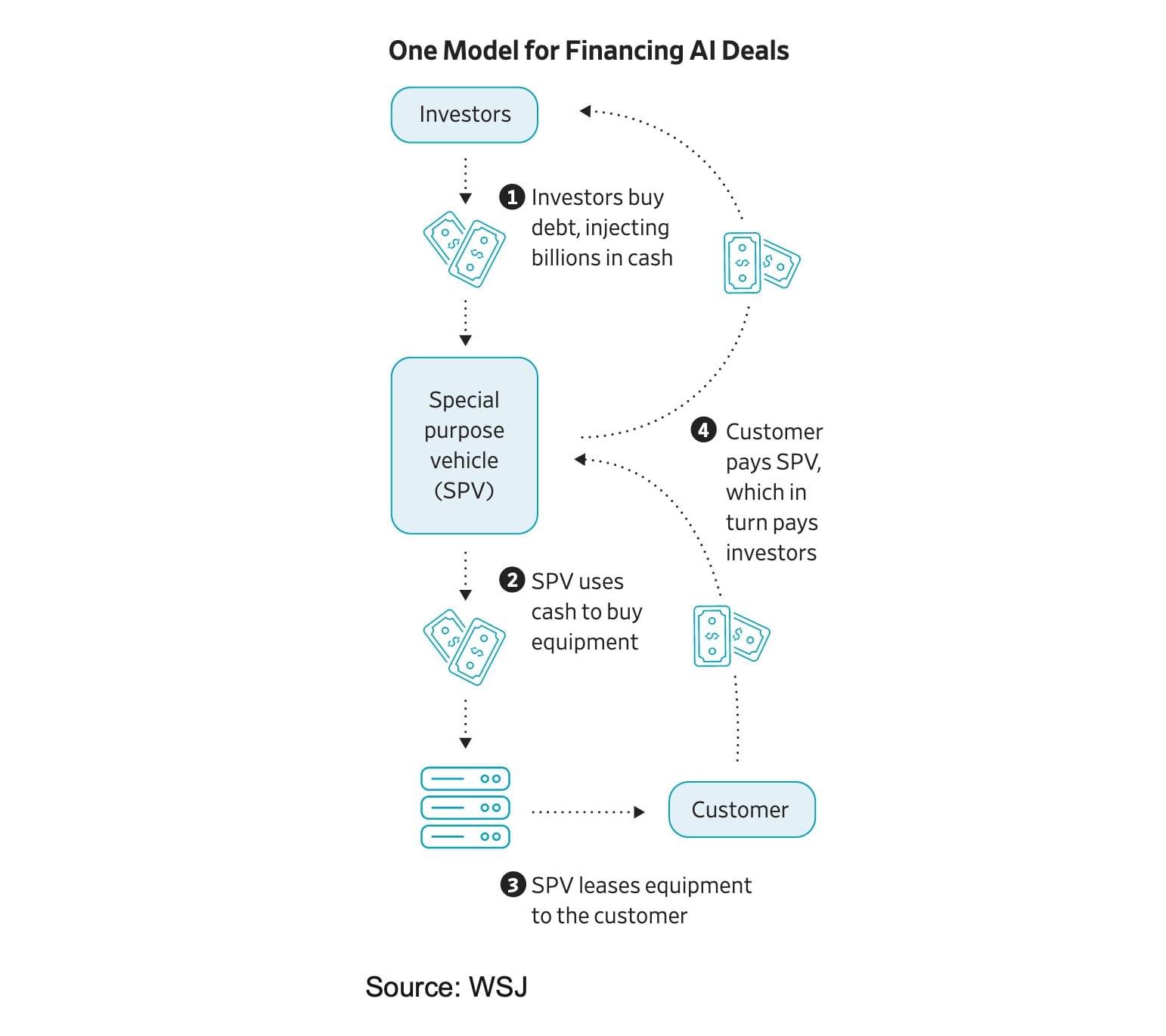
- What It Means: This is vendor financing moved off Nvidia’s balance sheet and scaled through private credit. Nvidia keeps selling chips, customers avoid paying upfront, and Wall Street distributes the exposure to insurers and pension funds. Residual-value guarantees do not remove the risk, but send it back toward Nvidia precisely when any decline in chip values would already be damaging its core business.
2. Hyperscalers Have Quietly Promised Another $1.5 Trillion
- What Happened: Alphabet, Meta, Microsoft, Amazon, Oracle, Nvidia and others now report roughly $1.5 trillion of purchase commitments, on top of an estimated $1.5 trillion in lease obligations. Alphabet alone reported $811 billion, including long-term infrastructure and take-or-pay energy contracts. Many (if not most) of these obligations remain outside conventional debt measures. Financial Times
- What It Means: Hyperscalers are using contracts to create leverage without calling it debt. These commitments reduce future flexibility and make the build-out increasingly self-reinforcing: revenue must grow because the spending has already been promised. If demand disappoints or prices fall faster than revenue rises, the obligations remain while the expected cash flows go pfft.
3. More Workers Are Producing the Training Data for Their Robot Replacements
- What Happened: Tens of thousands of Indian workers are recording first-person video of stitching, welding, assembly and other physical tasks. Robotics companies use the footage to teach machines the embodied skills that cannot be learned from internet text. Workers generally receive modest supplemental pay and often know little about the eventual use or ownership of the data. Bloomberg
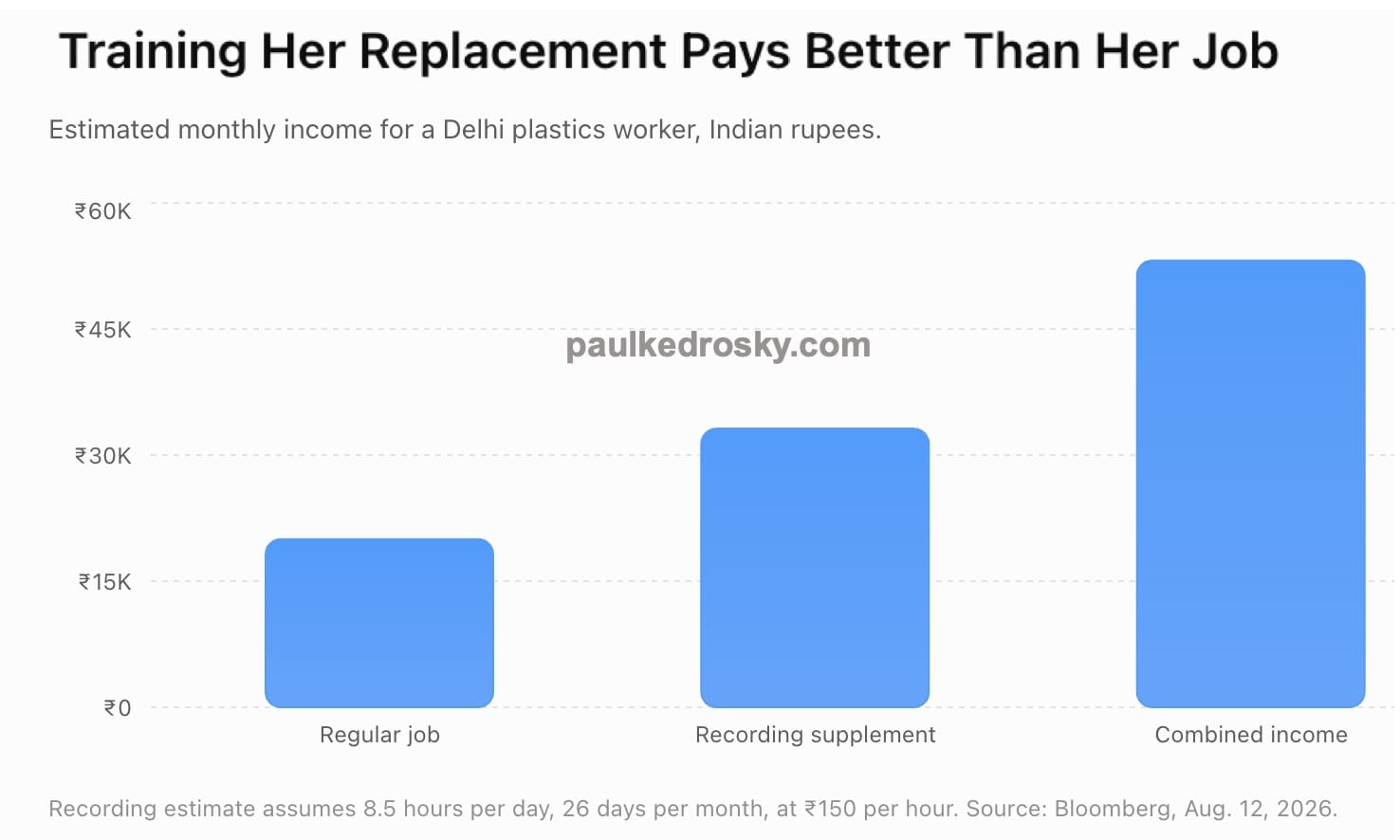
- What It Means: Workers’ accumulated knowledge is being extracted at low cost. It is the physical-world equivalent of scraping the internet, except the source material is a worker’s body and the intended product is the elimination of the work itself. And this development, of course, is being celebrated with the 8000x oversubscribed Unitree IPO. Reuters
4. The Data-Center Boom Creates Good Jobs, Briefly and Unevenly
- What Happened: Searches for data-center jobs on Indeed are eight times their early-2022 level. The jobs carry large wage premiums: 42% for installation and maintenance workers, as much as $50,000 annually for facilities managers, and $30,000 for construction managers. Indeed Hiring Lab
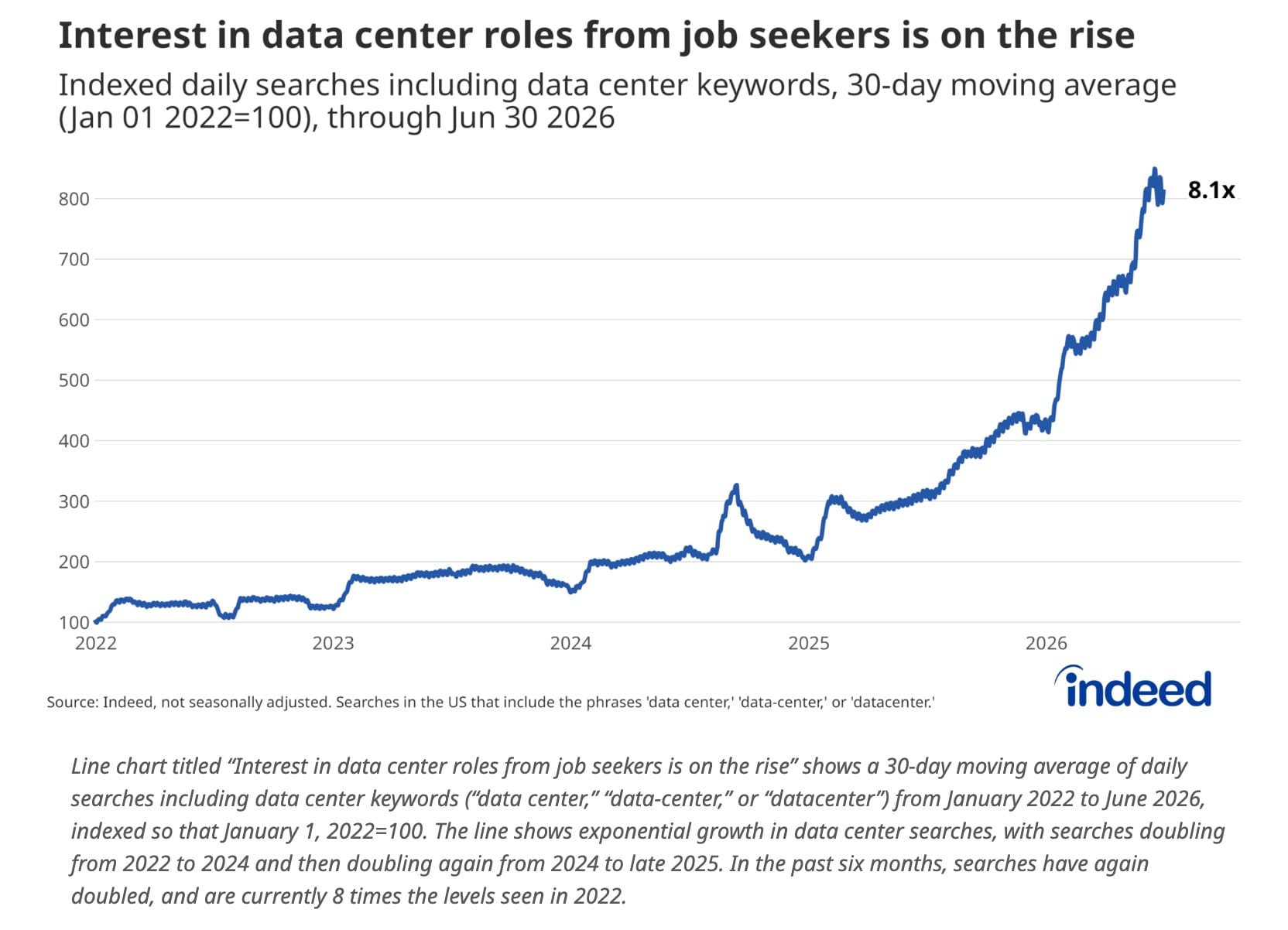
- What It Means: The build-out is genuinely valuable to electricians, technicians and specialized construction workers. It is not a broad labor-market solution: the workforce is specialized, rarely drawn from unrelated occupations, and temporary.
5. Bridgewater Sees the AI Boom Entering Its Riskier Financial Phase
- What Happened: Uber AI bull Greg Jensen at Bridgewater is reversing course somewhat, arguing that frontier labs face slower revenue growth, adoption friction, cheaper competition, tighter regulation and a looming capital crunch. Bridgewater