

What's ahead:
- The Balance Sheet Is Catching Up
- The Risk Has to Land Somewhere
- The Serial Fraction Wins
- Capability Can Become Correlation
- China Is Building Around the Chokepoints
The Balance Sheet Is Catching Up
What Happened
The financing side of the AI boom is adding new frictions. Rating agencies are waking up, a little, and taking a harder look at hyperscaler spending and contractual commitments. US technology companies are borrowing deeply enough in overseas markets that their issuance squeezing out other issuers. Meanwhile, a growing wall of take-or-pay compute contracts is scheduled to begin billing as new capacity comes online.
What It Means
AI infrastructure has passed the point where balance sheets bind, and reached a scale where the capital markets themselves become a constraint. The industry spent the first phase buying capacity and worrying later about how the commitments would be funded. That worked while revenue expectations, credit ratings and access to capital were strong. All three are about to best tested at once.
Related reading: FT on hyperscaler ratings · FT on Swiss credit · The Teaser Period
The Risk Has to Land Somewhere
What Happened
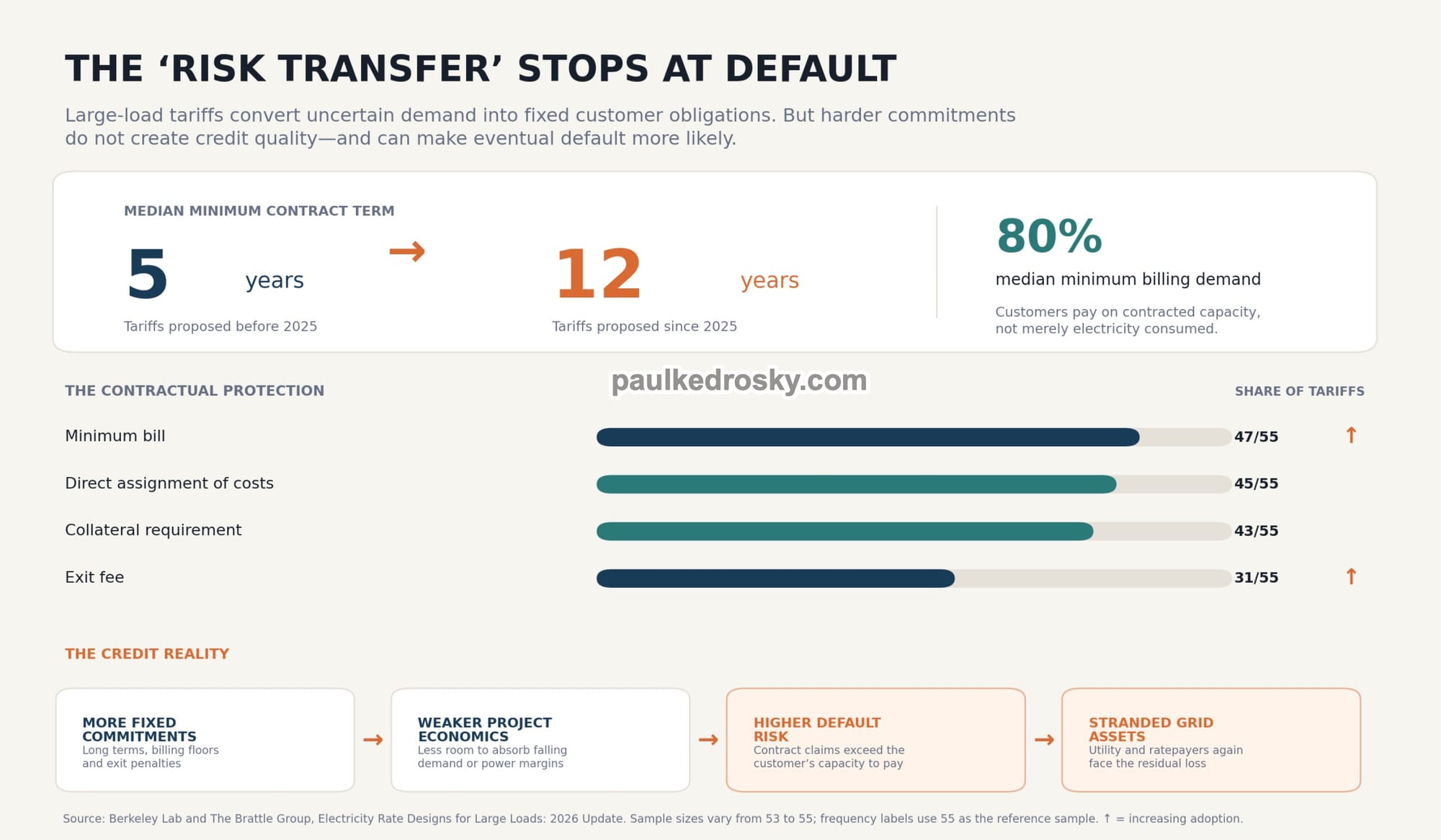
Utilities are rapidly rewriting tariffs for data centers and other very large loads. Longer contracts, minimum bills, collateral requirements and minimum demand charges are becoming common ways to protect utilities from unused infrastructure. At the same time, insurers see data centers as a major new source of premiums, just as competition is pushing the insurance industry toward looser pricing and greater exposure to unfamiliar risks. Some large data-center projects are already encountering delays.
What It Means
The argument over data-center economics is turning into an argument over who owns the downside. Utilities want protection if customers disappear or use less power than promised. Insurers are being paid to absorb construction and operating risks. Developers want financing before demand is proven. Each layer can protect itself contractually, but the underlying project risk remains. The more aggressively it gets redistributed, the harder it becomes to see where the eventual loss sits—other than everywhere, of course.
Related reading: Berkeley Lab on large-load rate design · WSJ on data-center insurance · FT on insurance risk · Bloomberg on project delays
The Serial Fraction Wins
What Happened
Toby Ord has tried to formalize a model of an intelligence explosion, or what the AI bros called RSI (recursive self-improvement). When would AI-driven AI research could produce accelerating capability gains?
What It Means
One way to think about this is Amdahl's Law from Computer Science: if some portion of the improvement cycle remains serial, adding more intelligence or more copies eventually produces sharply diminishing gains in speed. This puts a ceiling on the most aggressive recursive-improvement scenarios. Training runs take time. Experiments have to finish. Results have to be evaluated. Some decisions depend on previous decisions. Any stubborn serial part of the cycle eventually dominates as everything else accelerates. Recursive improvement can still be extremely fast—even dangerously so—but sustained super-exponential improvement requires the serial fraction itself to keep shrinking. That is a much less tractable problem than simply having some AI systems capable of doing AI research.
Related reading: The Dynamics of Intelligence Explosions · The Atlantic on Leopold Aschenbrenner
Capability Can Become Correlation Which Becomes Risk
What Happened
New work using simulated financial markets finds that more capable LLM agents can behave more similarly to one another, including when they are wrong. Under adverse information conditions, synchronized errors can persist across a population of agents. Separately, researchers leaving frontier labs continue to argue that increasingly autonomous systems are advancing faster than the institutions intended to control them.