


Here are recent rough notes from the site:
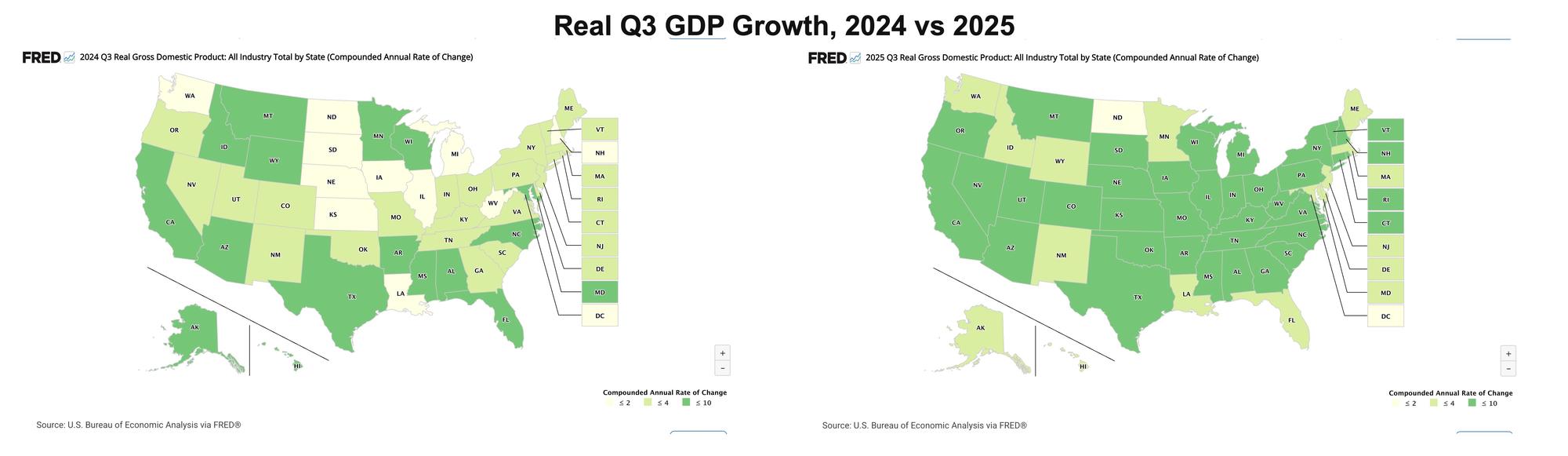
Remarkable Q3 real GDP growth figures in US, with all 50 state economies plus Washington, DC, growing. The natioanl average was 4.4% annualized, the median grew at 4.5% annualized, and Kansas grew fastest, at
at 6.5% annualized.
While data center capex played a role—at as much as half of GDP growth earlier in year—as I have discussed endlessly, there has been a broadening.
Retail equity ownership, even if it's been higher, was last at current levels in 1999, just before the dot-com crash, according to a new paper by Michael Mauboussin of Columbia and Morgan Stanley. The paper is worth reading in its entirety.
Who Is On the Other Side? A Framework for Understanding Market (In)Efficiency https://www.morganstanley.com/im/publication/insights/articles/article_whoisontheotherside.pdf

Frontier AI model companies are seeing declining returns on compute and power investment wrt incremental model capabilities. It's not that models aren't improving, but that it isn't keeping pace with the associated time and cost.
An FT piece argues this is analogous to what's happening with quant funds, creating a convergence of the two labs, to the point that one may eat the other.
https://giftarticle.ft.com/giftarticle/actions/redeem/900eba7c-f4ae-492f-bbe3-1e4f15a1e5f6

In talks and papers I often describe AI as a "rational bubble", a finance term describing asset valuations and investment being increasingly disconnected from cash flows, despite all actors being rational, not merely bananas.
There is a good new Chicago Fed paper laying and sythesizing the latest work on the topic, and it's a helpful framework.
Why Bubbles Occur: Revisiting the Rationality Debate
https://www.chicagofed.org/publications/economic-perspectives/2025/3
US and EU spending on AI continues to diverge widely, according to new Oxford Economics data. It is a confluence of things, from capital markets, to risk capital, to 'mericans being 'mericans, but the divergence is striking. https://www.oxfordeconomics.com/resource/no-us-style-ai-investment-boom-to-drive-eu-growth/
