

Here are ten recent rough notes from the site.
Fascinating paper on red queen competitive strategies among agentic AIs in a programmatic sandbox, and how the competition evolves. The main takeway: rapid evolution toward a general-purpose behavioral strategy. But, more insidiously, rapid synchrony in approaches, given similar reward functions, training data, etc. This, of course, is profoundly destabilizing. https://arxiv.org/abs/2601.03335
Long but fitfully worth reading "debate" between Michael Burry, Dwarkesh Patel, and Jack Clark about the costs and benefits of current AI. It somehow devolves into nuclear advocacy, which is weird, given that there are far more useul rabbit holes. https://post.substack.com/p/the-ai-revolution-is-here-will-the
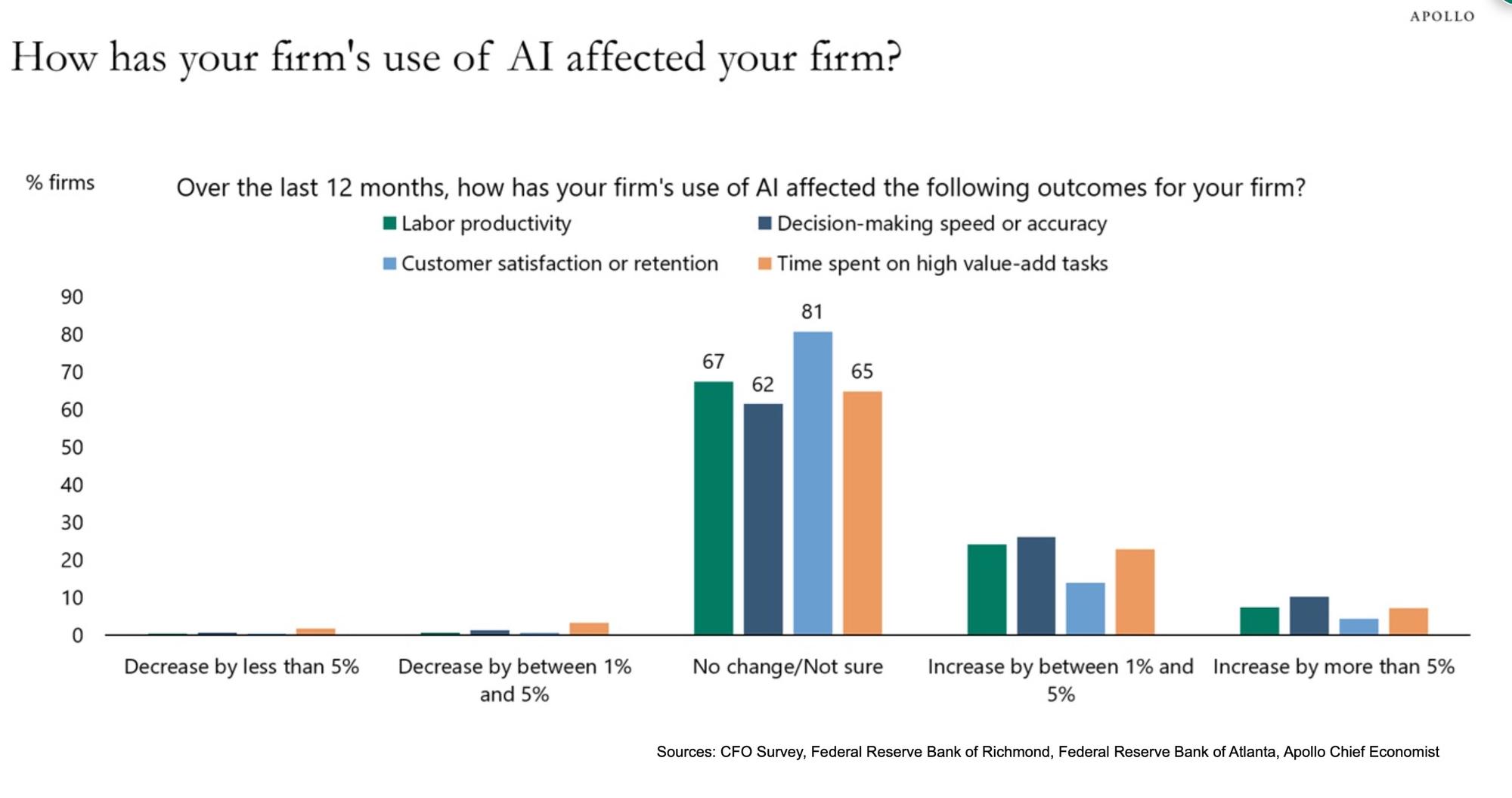
While surveys like this area always fraught, that the signal from in-firm AI usage isn't strong enough for most companies to say they are benefiting is striking. Again, early days, and an economy-wide 5% gain would be material for productivity, but the uncertainty is noteworthy.
So, I sort of agree with this from Michael Burry about how AI is already making trades inroads, but the trouble is time is not fungible, Just because I could do a bunch of things, with an LLM assist, doesn't meant I would or should do that. I see people constantly getting in over their heads by starting things. https://x.com/rohanpaul_ai/status/2010179244366938408
“[Americans] who live in the midst of democratic fluctuations have always before their eyes the image of chance; and they end by liking all undertakings in which chance takes a part.”
— Alexis de Tocqueville , from Democracy in America, Part II
One of the stranger claims about AI is that there isn't an AI bubble, there is an "everything bubble", across debt, equities, alts, private credit, etc.
Fair enough, but it is a little like telling a patient they have many things wrong, and then stopping triumphantly there.
Examples:
Unhedged https://www.ft.com/content/6e49718f-220b-4de9-87e3-7469df24a925
Richard Bernstein https://www.bloomberg.com/news/articles/2026-01-08/market-bubbles-go-way-beyond-ai-says-richard-bernstein-advisors
A major theme in capital markets in 2026 will be a tidal wave of AI-related IPOs, and not just the frontier model suspects. Bankers will drag out everything possible, most of which will be garbage, in an echo of the 1999 dot-com IPO wave. It's already started in China, and it's coming to the U.S.

Data center health impacts, from a new piece in The Lancet:
- The PM2·5 released from training a large AI model is more than that emitted during 10,000 round trips by car between Los Angeles and New York City
- Public health costs from air pollution attributed to data centres in the US alone projected to reach $10b-$20b per year by 2028
https://www.thelancet.com/journals/lancet/article/PIIS0140-6736(26)00033-4/fulltext?rss=yes
New BIS report on the AI spending ... enthusiasm, and it's somewhat more skeptical than I expected. It points to the potential for the inevitable reversal to have larger effects than one might expect, given it's rapid transition from equity to debt financing. https://www.bis.org/publ/bisbull120.pdf

Two books, one upcoming, and one recent, newly on my reading list:
1. Speed: How It Explains the World, by Vaclav Smil https://www.amazon.com/Speed-Explains-World-Vaclav-Smil-ebook/dp/B0DVGSKNR5
How the relentless pursuit of speed shapes technological landscape and social & environmental realities
2. The Land Trap, by Mike Bird
https://www.amazon.com/Land-Trap-History-Worlds-Oldest-ebook/dp/B0DW27PFL4
The role of land, through history, in making the rich richer and the poor poorer.