

Thinking about the current memory supercycle, and how it ends. Three perspectives ahead;
- Memory is building quickly toward its next glut
- HBM contracts are moving the cycle onto customers.
- Harnesses are taking over, reducing frontier model differentiation, and altering HBM required
1. Memory Is Building Toward Its Next Glut
What’s Happening
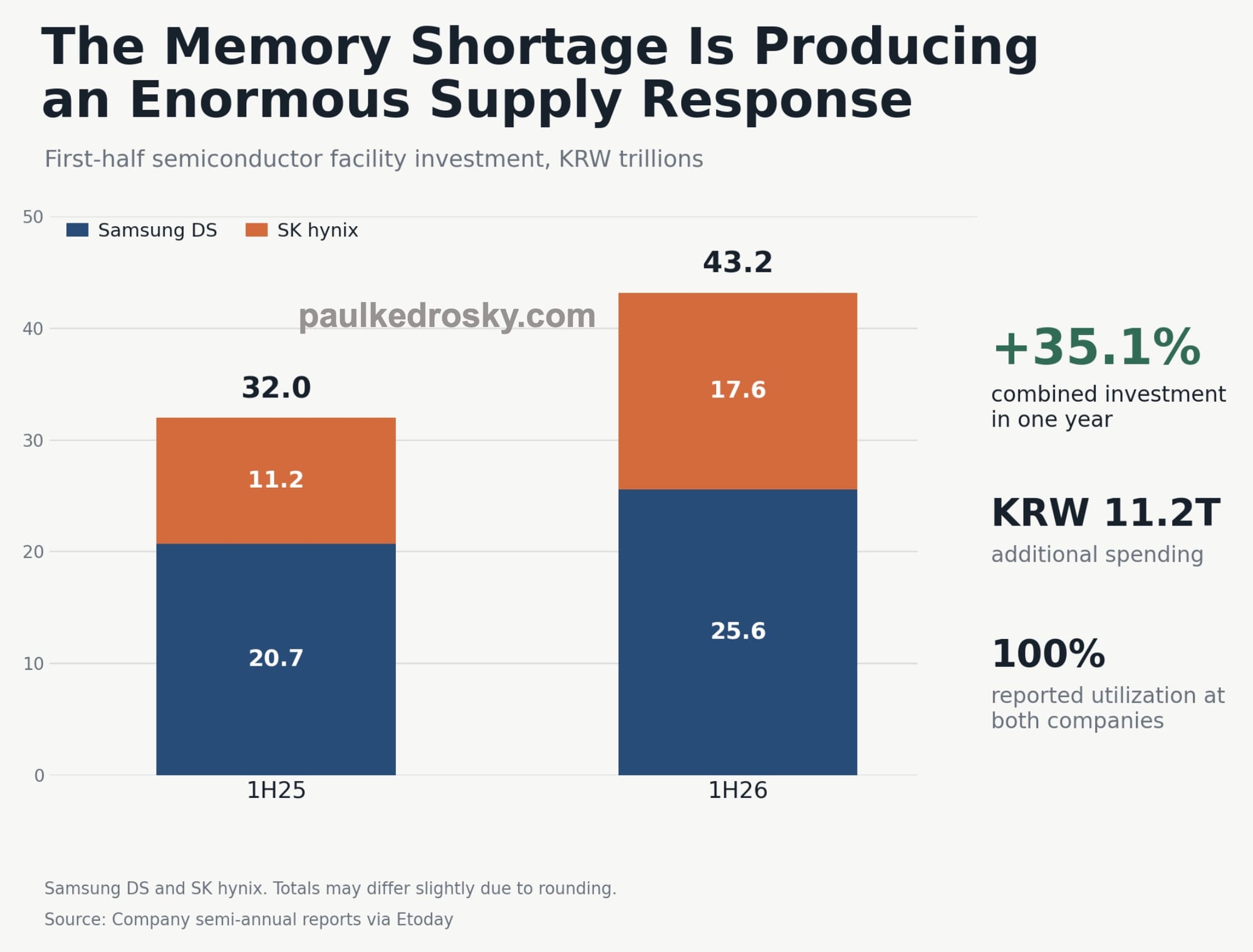
- Samsung and SK hynix spent KRW 43.2T on semiconductor facilities in the first half of 2026, up 35 percent.
- Micron spent another $7.1B in its latest quarter and continues to accelerate investment.
- This is the largest supply response in memory-market history.
- New fabs, process transitions, packaging capacity and yield improvements are all chasing the same demand forecasts.
What It Means
- The current shortage is seeding its reversal.
- Memory prices are set by marginal availability, so even a shrinking supply deficit can sharply reduce scarcity premiums well before the market reaches outright oversupply.
- The response will arrive unevenly, then suddenly.
- Multiple capacity, process and yield improvements will begin contributing at roughly the same time.
- Tightness may persist through early 2027, but the risk then flips.
- The capital already committed makes a severe 2028–29 downcycle increasingly plausible.
Source: Samsung · SK hynix · Micron · TrendForce