

December 14, 2025 Edition
This is a weekly free look of our premium Kedrosky Daily email. If you're not already a subscriber, sign up for a five-day preview.
Two Graphs

After Oracle delayed some data center projects, the yield on its 5.2% bond due 2035 jumped sharply, rising above US BBB bonds and approaching US BB (junk) bond yields—an unusual and significant sign of declining investor confidence.
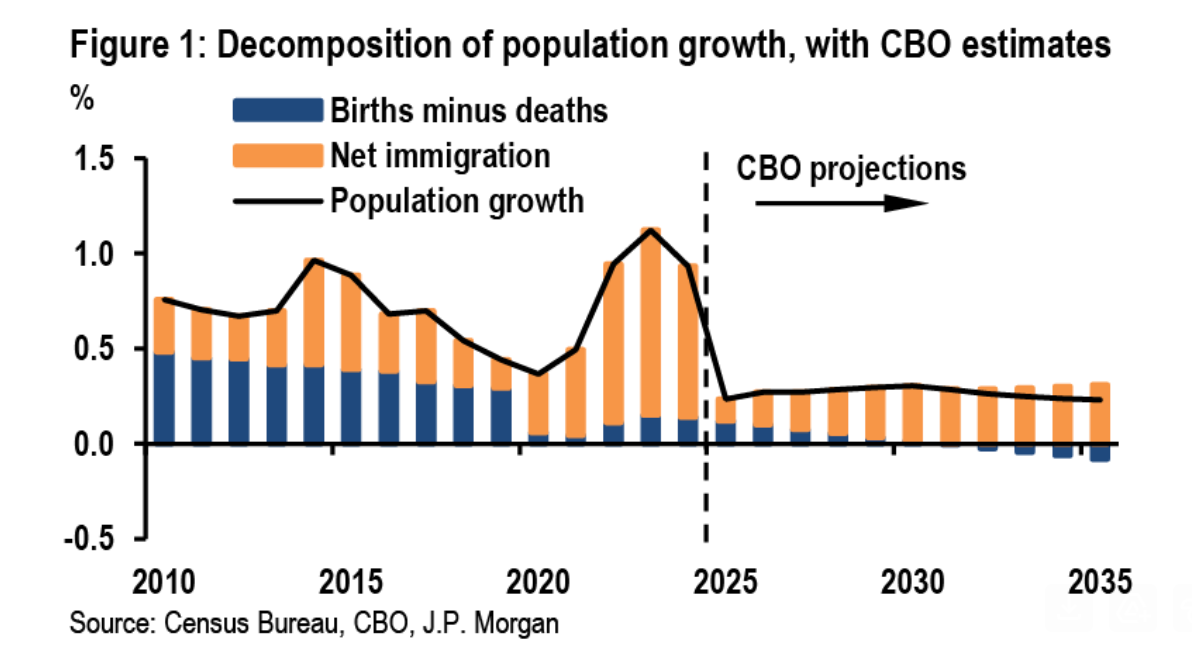
By 2030, net immigration is projected to be the primary—and nearly sole—driver of U.S. population growth, as births minus deaths turn negative.
Headlines
China’s Access to Powerful Nvidia Chips Comes at ‘Critical Moment’ (NY Times) … The Silicon Valley Campaign to Win Trump Over on AI Regulation (WSJ) … The Great Income Squeeze Begins as Fed Spells End to Easy Yields (Bloomberg) … Why the A.I. Boom Is Unlike the Dot-Com Boom (NY Times) … Massive Debt-Fueled Deals Are Back on Wall Street (WSJ) … Wall Street Is Shaking Off Fears of an A.I. Bubble. For Now. (NY Times) … Warner Bros.' Bidders Brace for a Fight That Will Last Months (Bloomberg) … Netflix vs Paramount: politics could decide battle for Warner Bros (FT)
The Idea
Mentions: geopolitics, technology, trade, emerging markets
Strategic trade alliances alter economic landscapes
The trend of geopolitical partners trading more with one another and less with rivals is reshaping international economic dynamics. This realignment affects global supply chains and may drive significant changes in global trade policies and business strategies over the next 24 months.
Related reading:
FreightWaves: McKinsey: Geopolitical partners trading more with one another, less with rivals
Financial Times: Strategic interdependence is rewiring the global economy
FreightWaves: The road ahead: Freight market trends & industry insights for 2025