

We are working on a few things related to AI and demographics, and this is a sneak preview of some of what is to come. In general, there is a view that, in an aging and shrinking workforce, AI could be a balm, providing labor cover as it replaces. This tension has investment and policy implications across sectors (healthcare vs software), locations, technology (robotics), and more.
To start things off, consider the following recent JPM graphic. It compares working-age population growth over the next decade with that of the prior two decades. The difference is stark in many developed countries, in particular in Western Europe and parts of Asia, but not limited to there.
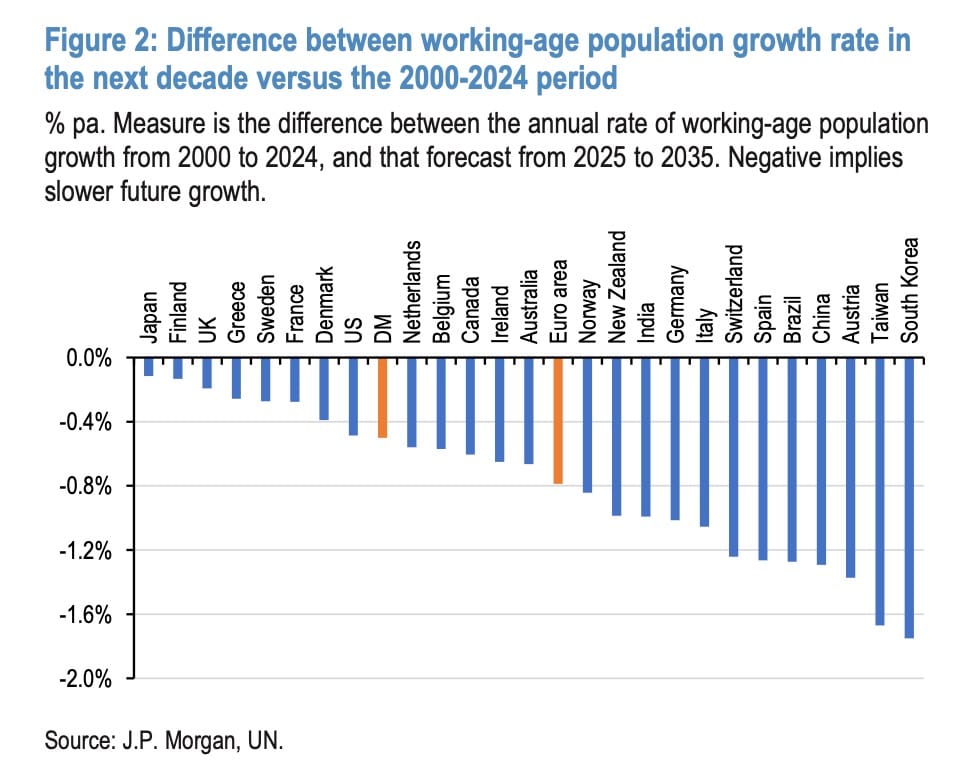
The implication, as the JPM writers point out, is that demographics will be a "considerable headwind" to economic growth relative to 2000-2024, which wasn't exactly the best of economic times in the first place, in many countries.
Can AI solve this problem? To advocates, replacing people with robots and AI is exactly what is needed, at least at the margin, demographically speaking. There is some early evidence that aging countries are among the fastest adopters of robots, for example, which puts them, to this way of thinking, at a kind of economic advantage, much like markets that skipped over wireless networks and went straight to wireless.
As ever, the answer is considerably more nuanced. While an aggressive adopter of robots, in part driven by aging, Japan is no economic exemplar.
To attempt to tie it all together, consider the following graphic. Demographic pressure is on the Y axis, AI pressure on the X, and then occupations are sorted by the extent to which the twinned forces reinforce one another, or act in opposite directions.