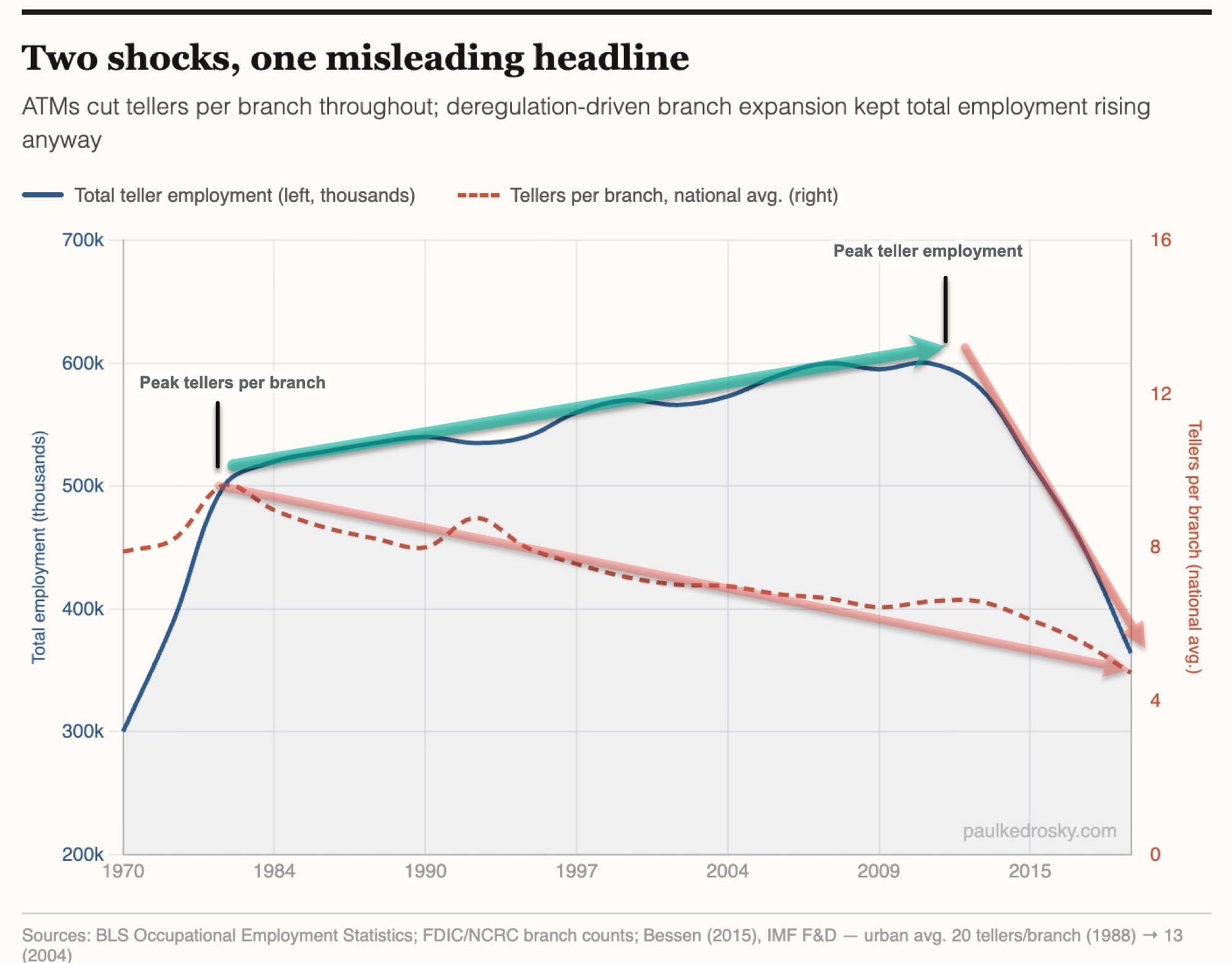
- ATMs did reduce teller labor demand — just not in the way the standard story claims.
- What kept total teller employment up was not automation-driven demand growth, but a massive branch expansion driven by deregulation.
- That matters because the ATM example is often misused as proof that task automation naturally creates offsetting new human work.
- The real lesson for AI is harsher: unless you can identify the offsetting force, job survival may be coincidence rather than mechanism.
The "ATMs didn't wipe out bank tellers" story is one of the most-retold in the automation-doesn't-kill-jobs genre. After all, putatively teller-replacing ATMs (automated teller machines) were widepread in the U.S. by the mid-1980s, and yet bank teller jobs persisted and grew for decades. Checkmate, anti-automation decel dude.
But this interpretation is misleading. ATMs proliferated through the U.S. in the 1980s and 1990s, and yet the total number of bank tellers rose. On these facts, everyone agrees.
What does it mean though? Economists and anti-anti-automaton types answer with a parable: automation transforms jobs rather than eliminating them. Tellers shifted from cash-handling to relationship banking. Everyone won. It's a clean story. It's a compelling story. And it is also wildly incomplete.
The following chart helps untangle things. While overall employment grew, tellers per branch fell steadily from ~1985 onward. That is the ATM effect, technology working exactly as you'd expect. eller employment fell, even if it was masked by more branches appearing.